Student Helpline! +91 9717172071
  Apply Here

The Real Challenges of MBBS in Russia
What Nobody Tells Indian Students — Until It’s Too Late
This article is not meant to scare you. It is meant to prepare you. Because the students who struggle are almost always the ones who were not prepared — and the ones who succeed are the ones who knew what was coming and chose to go anyway.
Every year, thousands of Indian families sit across a counsellor’s desk and ask: “Is Russia really a good option for MBBS?” The honest answer is: yes, it can be excellent — but only if you go in with your eyes open. At MBBSDirect, we have counselled over 10,000 students, accompanied them to Russia, and received calls at midnight from students who just want to come home. Here is the complete, unfiltered truth — and how to handle every challenge.
This is the first shock for most students. You land in Russia, excited, nervous, full of dreams — and you are taken to a hostel room where three other strangers will be sharing the same space as you. One room. Four beds. One small common bathroom. For the next 12 months, this is your home.
Back in India, most of these students had their own room. The idea of four people with different sleep schedules, different study habits, different levels of cleanliness, and different music tastes — it is a genuine shock to the system.
- University hostels are functional and safe — heating, kitchen on each floor, hot water, 24-hour security
- Rooms are roughly 12–18 sq. metres for 3–4 students — basic furniture per person
- Hostel is compulsory for 1st year at most universities — a sensible policy while you learn the city
- From Year 2 onwards, you can rent an apartment — rent ranges 15,000–25,000 Rubles/month shared
- Accept Year 1 in the hostel as your settling-in period — not a punishment
- Use this time to learn basic Russian, understand the city, and build your friend network
- Students who resist the hostel mentally suffer most. Students who embrace it come out fine
- Plan your apartment move for Year 2 — shared flat dramatically improves quality of life
Let us talk about food honestly. Not the brochure version — the real version. Most universities have an Indian mess facility. Many consultants sell this as a solution to all food-related worries. Here is what the brochures do not tell you:
- The wheat flour (maida/atta) is different — different gluten content, different milling. The roti tastes different.
- The rice is a different variety — different texture, different aroma. Students who ate rice daily notice immediately.
- Even vegetables are different — less acidic tomatoes, milder onions, different potatoes. The same recipe tastes different.
- Your Indian spices will run out. After that, you rely on Indian grocery stores — quality varies.
- If you are vegetarian, it is genuinely harder. Russian cuisine is heavily meat-based. Even vegetable soups are often made with meat stock.
Food is deeply tied to comfort, to home, to identity. When the food is off — even slightly — it adds to the cumulative weight of homesickness, language stress, and academic pressure.
- Learn to cook before you leave India — dal, chawal, a few sabzis, egg dishes. This is the single most practical piece of advice.
- Find Indian grocery stores near your university in the first week — not after six months. Cities like Tver, Voronezh, Stavropol, Krasnodar have them.
- Pack dry spices, pickle, and homemade masalas in your first luggage — these are emotional anchors for the first 2–3 months.
- Do not expect the food to ever taste exactly like home. The sooner you make peace with this, the better your experience will be.
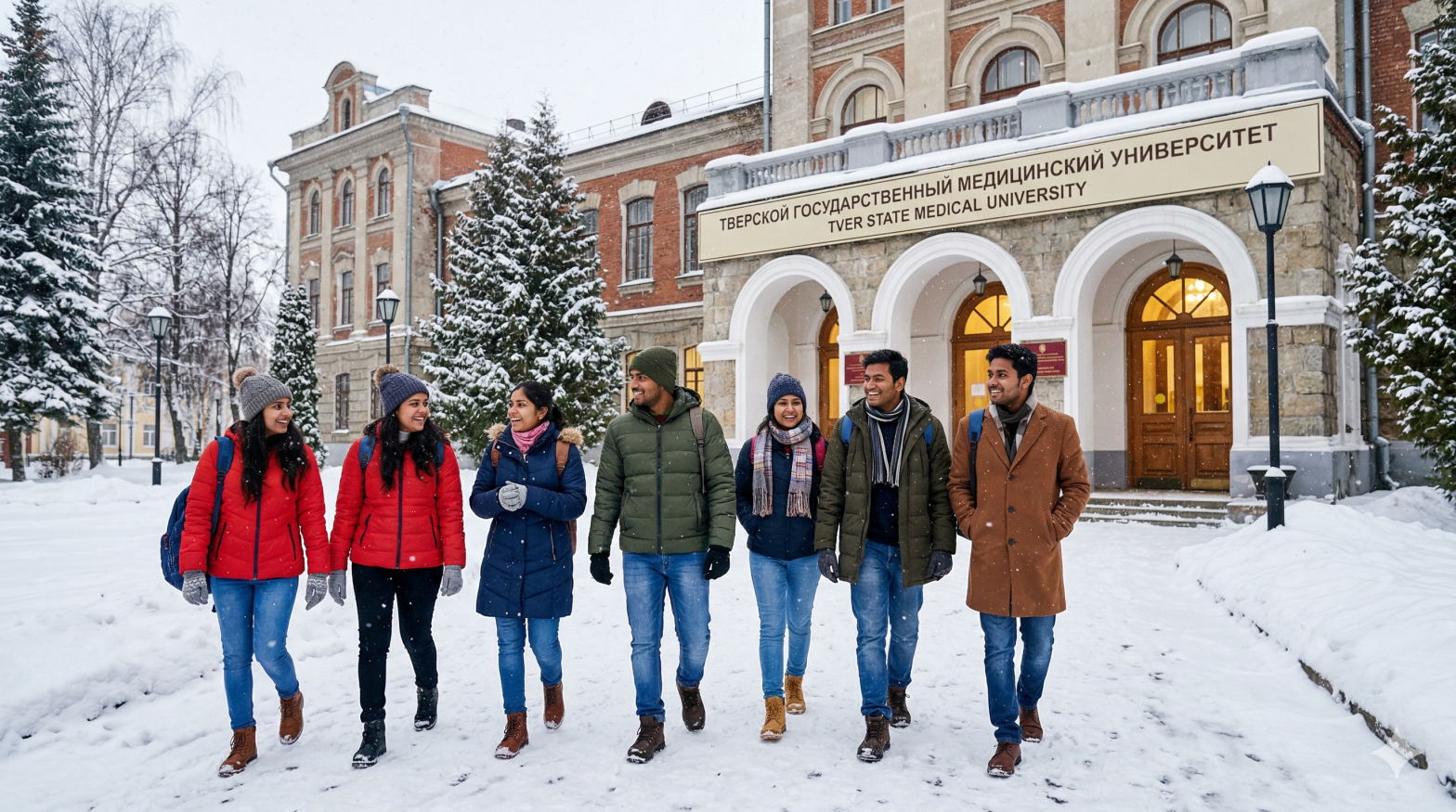
If you are from Mumbai, Chennai, Hyderabad, or even Delhi — you have no reference point for what −15°C to −25°C actually feels like. None. Reading about it does not prepare you. YouTube videos do not prepare you. Russian winters last roughly 4 to 5 months. November through March, temperatures remain below zero.
- Your body takes 3–6 weeks to adjust. During this time you will feel physically tired, skin will crack, lips will chap badly.
- You will not want to leave the hostel. This is when students start bunking classes — and academic performance first drops.
- Lack of sunlight affects mood and energy — only 6–7 hours of daylight by December. This is clinically recognised as Seasonal Affective Disorder.
- Everything takes longer — walking to university, getting food, doing laundry — all more effortful in deep winter.
- Invest in proper winter clothing before or in October in Russia — thermal innerwear, a heavy down jacket, waterproof insulated boots, gloves, and a warm hat covering your ears. Do not be budget-conscious here.
- Keep a strict daily routine during winter. Wake up, eat, and study at the same time every day. Structure fights low mood.
- Buy a daylight-spectrum LED lamp — well-known tool in northern countries, helps significantly with mood during dark months.
- Choose your city wisely — Stavropol, Krasnodar, Voronezh, and Bishkek have milder winters than Moscow, St. Petersburg, or Syktyvkar.
Here is a common misconception: many students think that because the MBBS course is taught in English, they do not need to learn Russian. This is wrong — and one of the most costly mistakes Indian students make.
Russian uses the Cyrillic script, has grammatical gender, and has 6 grammatical cases. A ‘hello’ is ‘zdravstvuyte’. ‘Where is the hospital’ is ‘gde bolnitsa’. None of it is intuitive for an Indian speaker.
- From Year 3 onwards, you do hospital rotations. Russian patients will not speak English. If you cannot communicate, you become a passive observer — not an active student.
- Basic survival requires Russian — reading grocery labels, talking to the hostel warden, going to a pharmacy when sick.
- Some professors switch to Russian mid-explanation in exams. Students who cannot follow lose marks.
- Bureaucracy — visa extension, registration, police verification — all require Russian. These are not optional situations.
- Take Year 1 Russian language classes seriously — attend every class, practice daily. Basic conversational ability in 12–15 months with consistent effort.
- Use apps alongside classes — Duolingo or Pimsleur Russian accelerate progress significantly.
- Talk to locals. Many Indian students spend all time within the Indian community and never actually practice Russian. Make Russian friends.
- Learn medical Russian separately from Year 2 — make vocabulary flashcards. This is the difference between passive and active clinical training.
This one is hard to write about because it is deeply personal. And because most students — especially Indian students who have been brought up to believe that emotion is weakness — will not admit to it.
Homesickness is not a character flaw. It is a physiological and emotional response to radical change. You have left behind your parents, friends, neighbourhood, food, language, festivals, and routines. You have replaced all of it with a cold foreign city, a small hostel room, and textbooks you need to memorise.
- Keep a structured daily schedule. Idle time is the enemy. Students who are busy with classes, study groups, cooking, and exercise have far less time to feel homesick.
- Set a fixed video call schedule — not multiple panic calls per day, but a fixed time. Constant unstructured contact keeps you mentally stuck in India.
- Celebrate Indian festivals with batchmates — buy mithai, cook something special. The gesture does not need to be elaborate. It matters emotionally.
- Find something you genuinely enjoy in Russia — the architecture, the libraries, a Russian friend. Students who find one thing they love settle down much faster.
- Do not make major decisions in the first 3 months. The urge to come home or transfer university is almost always acute homesickness — not an actual problem. Wait it out.
- Oral examinations — you sit in front of a professor, draw a question ticket, and answer verbally. Very different from MCQ-based NEET preparation. If you cannot express yourself clearly, you struggle regardless of how much you have studied.
- Attendance is strictly mandatory. Missing a certain percentage can result in failing to qualify for the exam itself — regardless of your knowledge.
- From Year 3, you are in the hospital every day — ward rounds, patient interactions, case studies. Students expecting classroom lectures only are unprepared for the pace.
- The syllabus is vast. Anatomy in Year 1 alone involves a level of detail that shocks most students. Students who thought MBBS abroad would be easier than India are very mistaken.
- Learn the oral exam format before you arrive — watch videos from Indian students in Russia who explain it. Oral exams require articulation, not just knowledge.
- From Day 1, attend every class. Treat attendance as non-negotiable. Students who maintain discipline in Year 1 almost always perform well in Years 4, 5, and 6.
- Build a study group from the first month. The Russian medical curriculum is not designed to be studied alone — group study works extremely well for oral exam format.
This challenge does not hit you on Day 1. It hits you at the end of 6 years. But the preparation for it should start on Day 1 — and most students realise this too late.
⚠️ The FMGE Pass Rate: A Statistic Every Student Must Understand
After completing MBBS from Russia, you must clear the FMGE (Foreign Medical Graduate Examination), now transitioning to NExT (National Exit Test), to practise medicine in India. The FMGE pass rate has historically hovered around 15–20% — meaning roughly 4 out of 5 students who appear fail it. This is not because Russian education is bad. It is because the Indian clinical examination environment is not something Russian universities prepare you for directly.
- From Year 3, start reading Indian-oriented MBBS revision books alongside your Russian curriculum — Marrow, PrepLadder. Use them consistently, not as a last-minute crash course.
- Budget 6–12 months of serious preparation after returning to India. FMGE/NExT is not something you clear by casually revising on the flight back.
- Any consultant who promises “guaranteed FMGE clearing” or claims 90% pass rates is misleading you. No consultancy can guarantee FMGE results — it depends entirely on the student’s own preparation.
- Ruble exchange rate fluctuates. The INR cost of your annual fees can vary significantly depending on when your family sends money.
- Indian debit/credit cards often do not work in Russia. You will need a Russian bank account or cash. Sort this out in the first week — not the second month.
- Unexpected expenses always happen. Your laptop breaks. You get sick. You need a ticket to visit a friend. An emergency fund of at least 30,000–50,000 Rubles is essential.
- The temptation to spend freely in Year 1 — eating out, travelling, shopping — can strain your budget badly by Year 2.
- Create a monthly budget and track it in a phone app. Separate fixed costs (hostel, food, transport) from variable costs (entertainment, eating out). Control variable spending from Day 1.
- Set up a Russian bank account in the first month. Tinkoff Bank and Sberbank are commonly used by students. Having a local card makes daily life vastly easier.
- Real monthly expenses: Hostel (10,000–15,000 Rbl) + Mess (12,000 Rbl) + Personal expenses (15,000 Rbl minimum) = plan for at least 37,000–42,000 Rbl/month. Agents who say 5,000 Rbl/month are wrong.
The Bottom Line: Hard, But Worth It — If You Are Prepared
Six years is a long time. There will be days in Russia when you question why you are there. Days when the cold gets into your bones, when the food feels wrong, when you miss your family so much it physically hurts, when you fail an exam you thought you had prepared for.
Those days do not mean you made the wrong decision.
MBBS students in Russia are dealing with cultural displacement, language barriers, and being far from home at a very young age. It is genuinely harder. And because of that, the students who come back as qualified doctors are genuinely tougher, more adaptable, and more worldly than many of their peers.
The challenges are real. They are not insurmountable. Thousands of Indian students have faced every one of them and come through. What separates the ones who succeeded is not talent or money or luck — it is preparation and mindset.
Go in knowing what is coming. Go in with the right university, the right support, and the right attitude. And you will be fine.
Need Honest Guidance for MBBS Abroad?
Talk to MBBSDirect — we prepare students for reality, not sell promises.
mbbsdirect.com · Since 2015 · 10,000+ Students Counselled