Student Helpline! +91 9717172071
  Apply Here

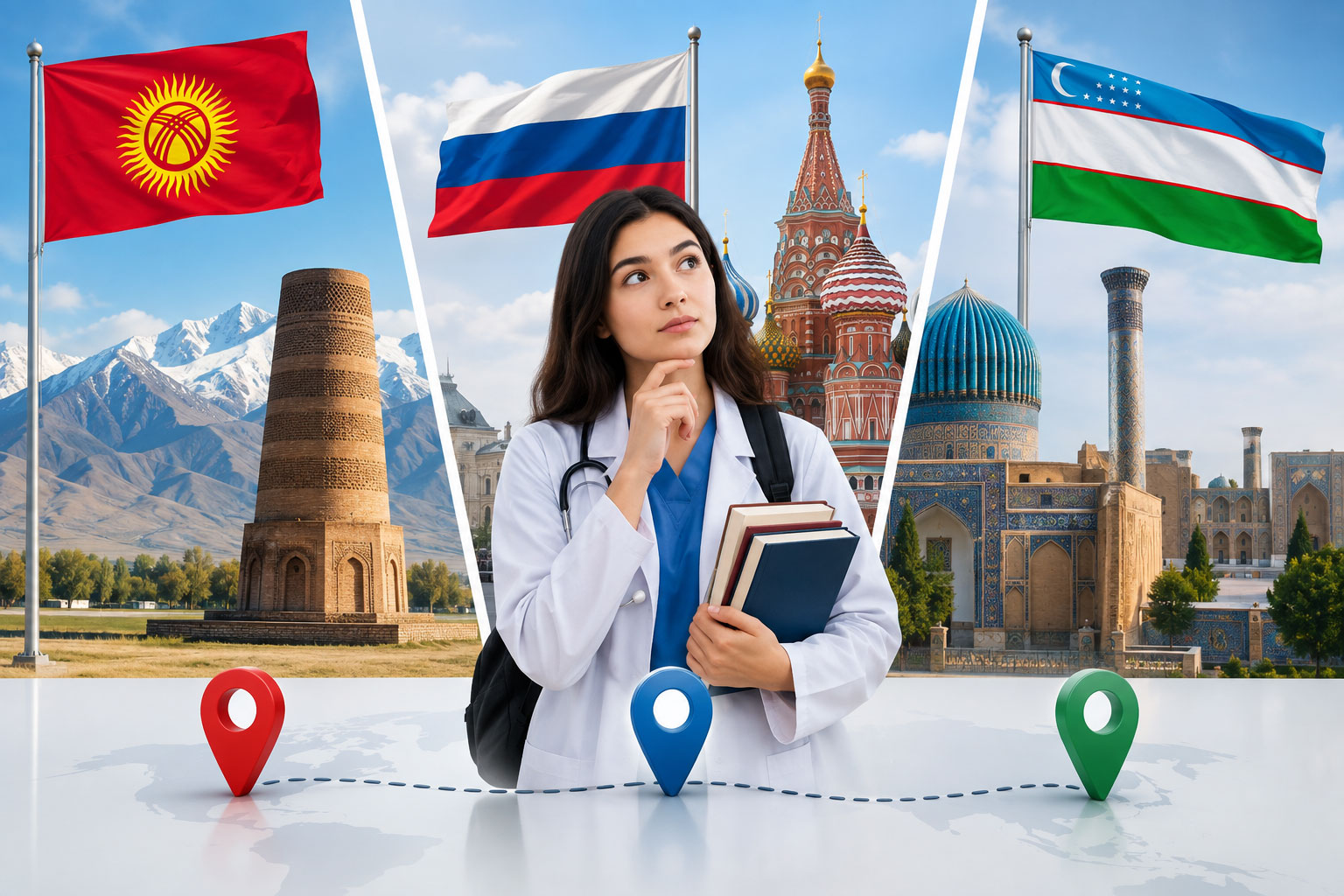
There is no single “best” country — it depends on your priorities. Kyrgyzstan is generally cheapest ($3,500–$6,000/year) but needs careful university-specific verification after the 2026 accreditation reform. Russia offers the largest, longest-established base of NMC-recognised universities. Uzbekistan sits in between on cost, with its own set of NMC-flagged institutions to avoid. University-specific FMGE data matters more than country choice in all three.
If your shortlist for MBBS abroad has narrowed down to Kyrgyzstan, Russia, and Uzbekistan, you’re in good company — together they account for a large share of Indian medical students studying overseas. But “which is best” isn’t a single answer; it depends on what you’re actually optimising for. Here’s an honest, side-by-side look.
Cost
Kyrgyzstan is generally the most budget-friendly of the three, with tuition typically ranging from roughly $3,500–$6,000 per year depending on the university. Uzbekistan sits in a broadly similar band, usually payable in US dollars. Russia’s fees vary more widely by city and university — some regional universities are comparable to Central Asian options, while established medical universities in bigger cities can cost more. Exact figures shift year to year, so treat any number here as a starting point for comparison, not a quote.
Regulatory Standing & NMC Recognition
This is where 2026 has made the comparison genuinely more complicated than it used to be:
| Country | 2026 Regulatory Situation |
|---|---|
| Kyrgyzstan | Major state accreditation reform: of 24 universities reviewed, 13 failed outright, 7 got one-year provisional status, 4 got full six-year accreditation. 3 institutions (incl. KRSU) are treaty-exempt. |
| Uzbekistan | NMC advisory in April 2026 named specific flagged institutions, largely over clinical training not happening in English despite official claims. |
| Russia | Longest track record of the three — a large, well-established base of NMC-recognised universities and a long history of Indian graduates clearing FMGE. |
The practical takeaway: don’t evaluate “the country,” evaluate the specific university’s current, verifiable status — all three countries now have both strong and risky options within them.
FMGE Outcomes
Outcomes vary more by institution than by country, but some broad patterns are worth knowing:
| Benchmark | FMGE Pass Rate |
|---|---|
| KRSU (Kyrgyzstan) ★ Top in KG | 39.66% |
| Kyrgyzstan National Average | 25.80% |
| Uzbekistan Country Average | ~10–22% |
Russia has historically posted comparatively strong outcomes at its established universities, though this varies significantly by specific institution and city; consistent country-level Russia data is less standardised than the figures above.
The pattern repeats across all three countries: ask for the specific university’s numbers, not the country’s.
Safety and Environment
Kyrgyzstan and Uzbekistan are both generally considered stable, welcoming environments for international students, with established Indian communities in the main university cities. Russia’s ongoing geopolitical situation means it’s worth checking current travel advisories for your specific region — most of the university cities Indian students study in are geographically well removed from active conflict areas, but this is exactly the kind of detail to confirm directly and recently rather than assume.
Language of Instruction
All three countries generally teach MBBS theory in English at NMC-compliant universities. Where it gets more nuanced is clinical training: from around the third year onward, hospital rotations in Kyrgyzstan and Uzbekistan often happen in Russian or the local language, since that’s what patients and staff speak day to day. Russia has similar dynamics in many of its universities. This isn’t unique to any one country, and it’s worth asking any university directly how they support English-speaking students through this transition.
Which Country Fits Which Student?
- Budget is your primary constraint and you’re comfortable with careful, university-specific due diligence: Kyrgyzstan’s exempted and fully-accredited institutions are worth serious consideration.
- You want the deepest, longest-established ecosystem of NMC-recognised options and a large alumni base: Russia typically offers that scale.
- You’re looking for a middle ground between cost and a growing, modernising education system: Uzbekistan is increasingly presented that way, provided you avoid the specific flagged institutions.
Frequently Asked Questions
No. The right answer depends on your budget, risk tolerance, and how much weight you put on a specific university’s track record versus the country’s general reputation.
Not automatically. Uzbekistan has its own NMC advisory concerns for specific institutions, and Russia requires the same university-level verification as any other destination.
Yes, there’s no rule against applying to multiple countries in parallel while you compare offers, timelines, and verified data.
There’s no single “best country” answer. The highest-performing individual universities in each country can outperform average institutions in the others.