
 Student Helpline! +91 9717172071
  Apply Here

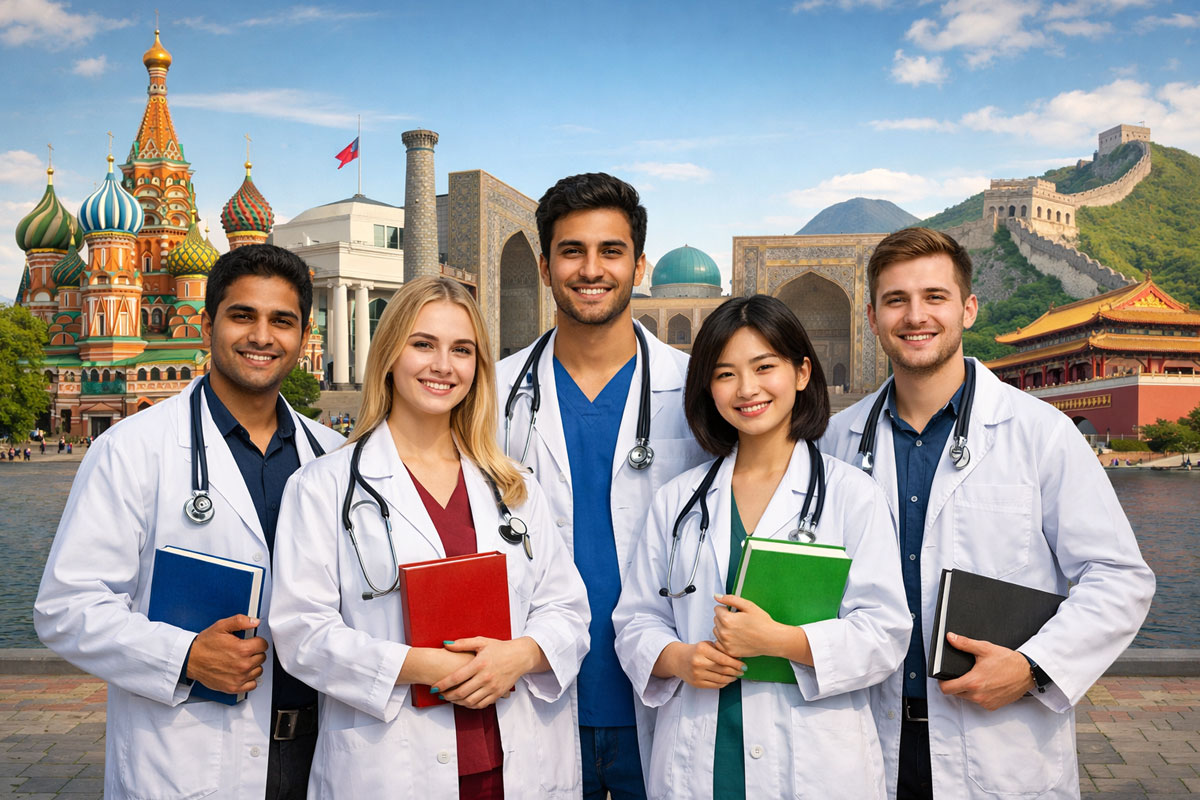
MBBS Abroad 2026: The Complete Roadmap for Indian Students
Everything you need to know about pursuing MBBS abroad — from NMC guidelines and choosing the right country to top universities, admission timelines, visa process, and living costs. Read this once and you won’t need to search anywhere else.
Table of Contents
- Why MBBS Abroad Is a Serious Option for Indian Students
- NMC Guidelines 2026: What Every Student Must Know
- The Best Countries for MBBS Abroad in 2026
- Countries to Approach with Caution
- Country-by-Country Deep Dive
- Top Universities for MBBS Abroad — 2026 List
- MBBS in China: Special Considerations
- Living Costs After Tuition, Hostel & Food
- Admission Timeline & Process
- Visa Process & Departure Window
- Hostel & Campus Life
- Frequently Asked Questions
1. Why MBBS Abroad Is a Serious Option for Indian Students
India produces approximately 1.5 lakh NEET-qualified students who are eligible for MBBS admissions every year. However, the total number of MBBS seats — government and private combined — is just over 1.08 lakh. This means that even students with a solid NEET score of 500–600 can find themselves without a seat in a government college, and private college fees in India can run anywhere between ₹60 lakh to ₹1.5 crore for the full course. For middle-class families, this is simply out of reach.
MBBS abroad, by contrast, offers WHO-recognised degrees from universities where the total cost of the entire 5–6 year programme — fees, hostel, food, and visa included — can be as low as ₹25–45 lakh. The curriculum is broadly comparable, the degree is NMC-recognised for FMGE/NExT eligibility, and the clinical exposure in large teaching hospitals is often excellent.
Beyond cost, there is a quality argument too. Several Russian, Kazakh, and Chinese medical universities rank in the QS World University Rankings and appear on the WHO World Directory of Medical Schools. Indian students at these universities have consistently passed the FMGE at rates that prove the education quality is real, not merely on paper.
2. NMC Guidelines 2026: What Every Student Must Know
NEET Qualification is Mandatory
As of 2023, NEET qualification is compulsory for all Indian students seeking admission to any foreign medical university with the intent to practice in India. There is no minimum cutoff score — you only need to have cleared the exam (appeared and qualified). However, you must carry your NEET scorecard as part of your application and visa documents.
The University Must Be on the WHO World Directory
The foreign university must be listed in the WHO World Directory of Medical Schools. This is a non-negotiable requirement. Before applying to any university abroad, verify its listing at search.wdoms.org. An unlisted university means your degree will not be recognised by the NMC, and you will not be eligible to appear for FMGE/NExT.
Minimum Duration of Study
The NMC requires that the medical programme be of a minimum duration that results in at least 54 months of academic study plus 12 months of clinical internship — in effect, a 6-year programme (some countries like Kyrgyzstan have a 5-year degree plus separate Internatura). Programmes shorter than this threshold are not recognised.
The NMC’s Requirement on Country Licensing
This is the most misunderstood — and most important — NMC guideline, and one that many agents and consultants deliberately avoid mentioning. The NMC has established that a graduate from a foreign medical university must obtain a license to practise medicine in the country where they completed their MBBS programme — before they can be considered for full registration in India.
This requirement was introduced to ensure that Indian students abroad are genuinely completing their training and meeting the clinical standards of their host country, not just collecting a paper degree and returning. In practical terms, it means that returning to India immediately after graduation and appearing for FMGE/NExT is no longer the only step — the country-specific licensing process matters too.
FMGE / NExT — The Indian Licensing Exam
Once you return to India with your foreign MBBS degree and the required country license, you must pass the Foreign Medical Graduate Examination (FMGE) — which is being phased into the new National Exit Test (NExT) framework under NMC’s revised medical education policy. Passing FMGE/NExT, followed by a 1-year internship in India, leads to provisional registration with your State Medical Council and eventually permanent registration. Students who have studied in good universities with a rigorous clinical curriculum consistently perform better in FMGE/NExT.
Quick NMC Checklist
- NEET qualified (any score, but must have appeared and passed)
- University listed in WHO World Directory of Medical Schools
- Programme duration: minimum 54 months study + 12 months internship
- University must not be on the NMC’s negative list
- Obtain country-of-study medical license post-graduation
- Pass FMGE / NExT on return to India
- Complete 1-year internship in India
3. The Best Countries for MBBS Abroad in 2026
After evaluating NMC compliance, licensing pathway ease, education quality, FMGE results, total cost, safety, and quality of life for Indian students, five countries stand out as the strongest choices for MBBS abroad in 2026. Each has a clear, achievable licensing pathway that satisfies the NMC’s country-license requirement.
- 6-year MBBS programme in English/Russian
- Licensing: Akkreditatsiya exam (3-stage)
- Large, established Indian student community
- Strong India–Russia diplomatic relations
- WHO-listed universities across the country
- 5-year MBBS + 1-year Internatura
- Licensing: Attestation exam (3-part)
- Most affordable option in Central Asia
- 3-hour direct flight from Delhi (Bishkek)
- Very high FMGE pass rates from top unis
- 6-year MBBS programme (DYA embedded)
- Licensing: Medical Practice License via State Final Attestation
- Rapidly modernising healthcare system
- Affordable living costs, growing Indian community
- Top universities NMC-recognised
- 5-year degree + 1-year Internatura
- Licensing: Sertifikatsiya (MCQ + OSCE) via elicense.kz
- Most advanced digital licensing in Central Asia
- Modern infrastructure; QS-ranked KazNMU
- Affordable, well-structured programmes
- 6-year MBBS (5 academic + 1 internship)
- Licensing: NMLE — conducted entirely in Mandarin
- High-ranking universities, excellent infrastructure
- 95%+ Indian graduates return for FMGE instead
- Only choose if committed to learning Mandarin
4. Countries to Approach with Caution
⚠️ Georgia — The Licensing Problem Nobody Tells You
Georgia is aggressively marketed as an MBBS destination, and on the surface — English medium, relatively affordable, European country — it sounds attractive. However, there is a critical issue with the licensing pathway that most agents deliberately omit: simply completing the 6-year MBBS in Georgia does not make you eligible for a Georgian medical license.
In Georgia, a graduate must either complete a postgraduate residency (PG) programme or complete a 2-year internship after their MBBS before they can sit the licensing exam and obtain a practicing certificate. This means the effective course duration becomes 6 + 2 = 8 years before you can satisfy the NMC’s country-license requirement. For most Indian students, this is neither financially nor practically viable. Always verify this with your consultant and check the Georgian National Medical Licensing Exam (NMLE) requirements directly before applying.
⚠️ Armenia — Education Quality Concerns
Armenia has been promoted as a budget MBBS destination in recent years, but consistent concerns have emerged about the quality of medical education in several Armenian universities. FMGE pass rates from Armenian medical universities are among the lowest of any MBBS-abroad country. Clinical exposure in many hospitals is reported to be limited, and faculty quality has been questioned in student feedback studies. While Armenia is not categorically off-limits, the risk-to-reward ratio is unfavourable compared to the top-performing countries. It is advisable to avoid Armenia unless you have specific, verified information about a particular university’s outcomes.
⚠️ Bangladesh — Unstable Situation
Bangladesh has historically been a popular MBBS destination for Indian students given its geographic proximity, similar language environment, and affordable costs. However, the political and security situation in Bangladesh has been significantly unstable in recent years, causing disruptions to academic calendars, campus safety concerns, and uncertainty around examination schedules. Until the situation stabilises meaningfully, it is advisable to consider Bangladesh a lower-priority option. Your education — 5 or 6 years of your life and your family’s investment — deserves a stable, secure environment.
5. Country-by-Country Deep Dive
🇷🇺 Russia — The Gold Standard of MBBS Abroad
Russia has been the most popular MBBS-abroad destination for Indian students for over three decades, and for good reason. The country has over 40 NMC-approved medical universities spread across its vast geography, fees ranging from ₹4 lakh to ₹10 lakh per year (with the best universities available in this range), and an Indian student community that is large, well-established, and supportive.
India and Russia share historically warm diplomatic ties, which translates into practical benefits: smooth visa processing, Indian consulate support across multiple Russian cities, and strong bilateral agreements on educational recognition. After your MBBS, the Akkreditatsiya examination — Russia’s 3-stage national licensing exam — is the pathway to the Russian medical license that satisfies the NMC requirement.
🇰🇬 Kyrgyzstan — Best Value in Central Asia
Kyrgyzstan has emerged as one of the most cost-effective and high-performing MBBS destinations for Indian students. The total course fee at a top Kyrgyz university is typically ₹2.5–4.5 lakh per year, and the country’s climate and food culture are broadly manageable for Indian students. Bishkek, the capital, is just a 3-hour direct flight from Delhi, making it the closest international MBBS destination in practical terms.
The licensing pathway — the Attestation exam (written, practical, and oral components) — while rigorous, is well-structured and achievable for students who have genuinely engaged with their 5-year curriculum and 1-year Internatura. FMGE pass rates from top Kyrgyz universities are among the highest of any MBBS-abroad country, reflecting genuine education quality.
🇺🇿 Uzbekistan — The Rising Star
Uzbekistan under President Mirziyoyev has undergone a significant healthcare and education reform programme since 2017. New medical universities have been established, existing institutions have been modernised, and the State Final Attestation (DYA) — which is built into the 6-year degree rather than being a separate post-graduation exam — means graduates emerge both with their degree and with the foundational credentials for a Medical Practice License. Tashkent, the capital, is a well-connected, modern city with a growing Indian community.
🇰🇿 Kazakhstan — Structured, Digital, Modern
Kazakhstan is the most technically advanced of the Central Asian MBBS options. The elicense.kz digital licensing portal, the OSCE-based Sertifikatsiya exam, and QS-ranked KazNMU make Kazakhstan a compelling choice for students who want a rigorous, modern medical education with a clear post-graduation pathway. Almaty is a cosmopolitan, safe city with international-standard infrastructure. The total programme is 5 years + 1 year Internatura, and the Sertifikatsiya exam is administered quarterly, giving students flexibility on timing.
6. Top Universities for MBBS Abroad — 2026 List
🥇 Kyrgyz Russian Slavic University (KRSU) — Bishkek, Kyrgyzstan
Top RankedKRSU stands out as the single best-performing MBBS-abroad university for Indian students based on student feedback, FMGE/NExT pass rates, and faculty quality. Founded in 1993 as a joint Kyrgyz-Russian educational initiative, KRSU operates to Russian academic standards — its curriculum, faculty credentials, and clinical facilities are held to a higher benchmark than most Kyrgyz universities.
Student testimonials consistently highlight the quality of teaching, the strength of clinical rotations at KRSU’s affiliated hospitals, and the university’s active support for FMGE preparation. The location in Bishkek is an additional advantage — the city is compact, affordable, safe, and just 3 hours from Delhi by direct flight. For families, this proximity means students can return home more easily, and parents can visit.
🥈 Voronezh State Medical University (VSMU) — Voronezh, Russia
Top 10 RussiaVoronezh State Medical University is one of Russia’s most respected medical institutions and consistently features in the Indian Consulate General St. Petersburg’s list of top-rated Russian medical universities for Indian students. Voronezh city itself is a major educational hub with a large Indian student population, well-developed Indian food infrastructure, and a pleasant climate — milder than more northern Russian cities.
VSMU’s clinical base includes Voronezh Regional Clinical Hospital and several specialised centres, ensuring strong clinical exposure during the 6-year programme. The university has a dedicated international student support office and a long track record of students performing well in FMGE. At approximately ₹5–7 lakh per year, it offers a strong quality-to-cost ratio.
Tver State Medical University (TSMU) — Tver, Russia
Established & ReliableTver State Medical University, located in Tver city just 180 km from Moscow, combines excellent location advantage with a strong academic reputation. The proximity to Moscow means students benefit from better infrastructure, easier travel connections (including flights home via Moscow Sheremetyevo), and exposure to a major metropolitan clinical environment. TSMU has a long history of training international students and maintains strong FMGE pass-rate records.
For students who want to be within easy reach of Moscow’s Indian community and amenities while benefiting from the lower costs of a non-capital city, Tver is an ideal location.
Yaroslavl State Medical University — Yaroslavl, Russia
Great Location + ValueYaroslavl State Medical University offers one of the best combinations of location, fees, and education quality in Russia. Yaroslavl — a beautiful UNESCO World Heritage city on the Volga river — is approximately 280 km northeast of Moscow, offering genuine Russian cultural immersion without the cost and congestion of a major metropolis. Fees at Yaroslavl are among the more affordable for a high-quality Russian medical university, typically starting at around ₹4–5 lakh per year.
The university’s modern simulation facilities, established Indian student community, and consistent FMGE performance make it a highly recommended choice for budget-conscious students who do not want to compromise on quality.
Stavropol State Medical University — Stavropol, Russia
Reputed & EstablishedStavropol State Medical University is one of Russia’s most established and reputed medical institutions, with a history dating back to 1938. Located in the Stavropol region of southern Russia, the university benefits from a relatively mild climate compared to central or northern Russian cities. It has a large and active Indian student community and strong clinical hospital affiliations in the region.
SSMU has consistently produced strong FMGE performers among Indian graduates and is well-regarded in the Indian medical education community for the quality of its faculty and the rigour of its clinical training programme.
Ryazan State Medical University — Ryazan, Russia
Moscow RegionRyazan State Medical University (I.P. Pavlov RyazGMU) is located in Ryazan, approximately 200 km southeast of Moscow. The university is named after the legendary physiologist Ivan Pavlov and has a strong research tradition. Its proximity to Moscow makes it an attractive option for students who value accessibility to India’s diplomatic mission, Indian stores, and travel connections, while studying in a smaller, more manageable city environment.
North-Western State Medical University — St. Petersburg, Russia
Major City AdvantageNorth-Western State Medical University (NWSMU), named after I.I. Mechnikov, is located in Russia’s cultural capital — St. Petersburg. This is a significant advantage: St. Petersburg is home to the Indian Consulate General for Northwest Russia, a large Indian diaspora, Indian restaurants, and world-class cultural infrastructure. The city’s international airport connects directly to multiple Indian cities.
NWSMU itself has excellent hospital affiliations throughout the city and a well-regarded faculty. Living costs in St. Petersburg are higher than in smaller Russian cities, but the lifestyle quality and support infrastructure compensate significantly.
Northern State Medical University — Arkhangelsk, Russia
Cold Climate WarningNorthern State Medical University (NSMU) in Arkhangelsk is a solid institution with good academic credentials and affordable fees. However, there is one very important practical note: Arkhangelsk is located in the far north of Russia, near the Arctic Circle. Winters here are extremely harsh — temperatures can drop to -30°C and below, and darkness during winter months is prolonged. Not all students are suited to this environment. If you are sensitive to extreme cold or are coming from a warm Indian state, factor this seriously into your decision. Students who adapt well to the climate report positive academic experiences, but it is a lifestyle commitment that must be made consciously.
Ivanovo State Medical University — Ivanovo, Russia
Near Moscow, Low CostIvanovo State Medical University offers an attractive proposition for students seeking a balance between location quality and cost. Ivanovo city is located approximately 280 km northeast of Moscow in the central European part of Russia, making it accessible and well-connected. The university’s fees are at the more affordable end of the spectrum for the Moscow region, and its academic quality — while not at the very top tier — is consistent and reliable. For students on a tighter budget who still want proximity to Moscow and a stable academic environment, Ivanovo is a genuinely good choice.
Syktyvkar State Medical University — Syktyvkar, Russia
Lowest Cost OptionFor students looking for the most affordable route to a Russian MBBS, Syktyvkar State Medical University offers fees starting at approximately ₹3.5 lakh per year — among the lowest of any NMC-recognised Russian medical university. Located in the Komi Republic of northwest Russia, Syktyvkar is a smaller city, which means lower living costs alongside lower tuition. The trade-off is a less developed Indian student community and a colder climate. For highly motivated students on a strict budget, this university represents genuine value.
Tashkent State Medical University — Tashkent, Uzbekistan
Uzbekistan’s BestTashkent State Medical University (TSMU) is Uzbekistan’s most prestigious and oldest medical institution, founded in 1919. Located in the heart of Tashkent — a well-connected, modern capital city with direct flights to Delhi, Mumbai, and other Indian cities — TSMU offers excellent location advantage alongside a strong academic programme. The city’s climate is pleasant (dry continental — hot summers, mild winters), the cost of living is very affordable for Indian students, and the Indian community in Tashkent is well-established.
Fees are competitive, the curriculum has been modernised under Uzbekistan’s healthcare reforms, and the university’s WHO listing ensures NMC eligibility.
Karakalpak Medical Institute — Nukus, Uzbekistan
Best Budget Choice (₹32L Total)For students with a total budget of approximately ₹32 lakh for the entire MBBS programme — including tuition fees, hostel, Indian food, and visa costs — Karakalpak Medical Institute in Nukus, Uzbekistan is the standout option. Located in the Karakalpakstan autonomous republic of Uzbekistan, it is not as centrally located as Tashkent, but for families prioritising total cost above all else, it provides genuine, NMC-eligible medical education at a fraction of the cost of most alternatives.
Students choosing this institution should be prepared for a more modest city environment, but the academic quality and WHO recognition ensure a legitimate pathway to FMGE/NExT on return to India.
7. MBBS in China: Special Considerations
China has some of the best-ranked medical universities in the world, excellent infrastructure, affordable fees, and a well-organised 6-year MBBS programme. On paper, it looks like one of the strongest options. In practice, the single factor that reshapes the entire calculus for Indian students is this: China’s national medical licensing exam — the NMLE (全国执业医师资格考试) — is conducted entirely in Mandarin Chinese. There is no English option.
This means that to obtain the Chinese medical license required by the NMC, a student must become proficient in medical Mandarin to at least HSK Level 5 — a high-intermediate standard. The overwhelming majority of Indian students at Chinese universities — roughly 95% or more — find this too challenging and choose to return to India after graduation to sit for FMGE/NExT instead. This is a perfectly valid choice (FMGE/NExT is in English, and China MBBS degrees are NMC-eligible), but it does mean that the country-license requirement becomes a longer-term challenge.
The honest advice: Only choose China if you are genuinely committed to learning Mandarin and are prepared to invest intensively in language from your very first year. Students who treat Chinese as a secondary concern, rely on English-medium materials throughout, and assume they can pick up enough language by Year 6 consistently struggle with the NMLE. If that commitment is real, however, China offers outstanding facilities and some of the world’s most impressive medical university campuses.
→ Read our complete guide: How to Practise Medicine in China — NMLE, Guipei & Career Paths
Top 4 Chinese Universities for MBBS in 2026
Xiamen University — Xiamen, Fujian Province
Highest World RankingXiamen University is one of China’s most internationally recognised universities, consistently appearing in major global rankings including QS and THE World University Rankings. Its medical programme benefits from world-class infrastructure, a beautiful coastal campus in Xiamen city (one of China’s cleanest and most liveable cities), and a strong research culture. For Indian students serious about a high-quality Chinese medical education and willing to commit to Mandarin immersion, Xiamen University represents the pinnacle of what’s available.
Xi’an Jiaotong University — Xi’an, Shaanxi Province
C9 League UniversityXi’an Jiaotong University is a member of China’s C9 League — the equivalent of the Ivy League in Chinese higher education. The medical school benefits from this elite institutional affiliation, with excellent research facilities, highly qualified faculty, and strong hospital partnerships. Xi’an is one of China’s most historically significant cities (home of the Terracotta Army) with a relatively lower cost of living than Shanghai or Beijing. XJTU is consistently ranked among China’s top 10 universities.
Nanjing Medical University — Nanjing, Jiangsu Province
Specialist Medical FocusNanjing Medical University is one of China’s dedicated, specialist medical universities — unlike Xiamen or XJTU which are comprehensive universities. This focused mission translates into deeper medical specialisation, stronger clinical partnerships, and a curriculum that is specifically designed around producing excellent clinicians. Nanjing is a major, well-connected city in eastern China with good international transport links. NMU is WHO-listed and NMC-eligible.
Zhejiang University — Hangzhou, Zhejiang Province
QS Top 100 GlobalZhejiang University consistently ranks in the global QS Top 100 and is one of China’s most prestigious and research-intensive institutions. Located in Hangzhou — a beautiful city often described as China’s most liveable — ZJU’s medical school benefits from excellent affiliated hospitals, a modern campus, and an internationally diverse student body. For students seeking the best possible Chinese university experience and prepared to work hard on both medicine and Mandarin, Zhejiang University is among the finest options in China.
8. Living Costs: What to Expect Beyond Tuition, Hostel & Food
When a university quotes you a fee that includes tuition, hostel accommodation, and a meal plan or Indian food provision, that covers your primary fixed costs. However, daily life involves additional spending that students often underestimate in their planning. Based on feedback from thousands of Indian students currently studying in Russia, Kyrgyzstan, Uzbekistan, Kazakhstan, and China, the realistic additional monthly living expense — excluding tuition, hostel, and food — falls in the range of ₹20,000 to ₹30,000 per month.
| Expense Category | Monthly Estimate (INR) | Notes |
|---|---|---|
| Personal groceries & snacks (beyond meal plan) | ₹3,000–5,000 | Indian snacks, tea, familiar items from Indian stores |
| Local transport (metro, bus, taxi) | ₹2,000–4,000 | Most universities are near city centres; public transport is cheap |
| Mobile phone & internet (local SIM) | ₹500–1,000 | Local SIM plans are very affordable in all 5 countries |
| Stationery & books | ₹1,000–2,000 | Most textbooks are available digitally; PDFs reduce cost |
| Personal care (toiletries, haircut, etc.) | ₹1,500–2,500 | Most items available locally; some Indian brands at Indian stores |
| Entertainment & social activities | ₹2,000–4,000 | Cinemas, restaurants, travel — all cheaper than India’s metro cities |
| Clothing & seasonal items | ₹2,000–4,000 | Higher in winter — warm clothing is an upfront cost in Year 1 |
| Miscellaneous / emergency buffer | ₹3,000–5,000 | Always maintain a buffer — medical costs, unexpected expenses |
| TOTAL PERSONAL EXPENSES | ₹15,000–27,500/month | Budget ₹20,000–30,000/month to be comfortable |
9. Admission Timeline & Process for 2026 Intake
Admissions Open
Admission portals for the 2026 intake open on or around 15 April for most universities. This is when you can begin submitting applications, uploading NEET scorecards, and communicating with universities or authorised admissions partners like MBBSDirect.com.
Document Preparation & Early Applications
Prepare your complete document set: NEET scorecard, Class 10 and 12 mark sheets, passport (must be valid for at least 2 years), passport-sized photographs, medical fitness certificate, and police clearance. Top universities begin reviewing applications from this period. Note: some universities conduct their own entrance examination — this is typically an online test covering Biology, Chemistry, and English, scheduled in April–May.
Top University Seats Begin Closing
The highest-demand universities — KRSU, Voronezh, Tashkent Medical, KazNMU, and the top Chinese universities — begin filling their available international seats by mid-June. Applications submitted after this date for these universities may find limited seat availability or waiting list status. Seats are allocated on a first-come, first-served basis. Earlier applications have a significant advantage.
All Admissions 100% Closed
By 15 August, admissions are fully closed across all universities covered in this guide without exception. No applications are accepted after this date for the 2026 intake. Students who miss this window must wait until the 2027 admission cycle. Do not wait.
Eligibility Requirements (Quick Summary)
- NEET qualified (any passing score — must have appeared and cleared)
- Class 12 with Physics, Chemistry, Biology and English — minimum 60% aggregate (50% for SC/ST/OBC candidates)
- Minimum age: 17 years as on 31 December of the admission year
- Valid Indian passport (minimum 2 years validity recommended)
- No criminal record (police clearance certificate may be required)
- Medical fitness certificate from a registered doctor
10. Visa Process & Departure Window
University Sends Invitation / Visa Support Letter
After your admission is confirmed and fees are paid, the university issues an official Invitation Letter (in Russia, this is the formal visa invitation; in other countries it may be called an Admission Letter or Visa Support Letter). This document is the foundation of your visa application and is issued by the respective country’s Ministry of Foreign Affairs or Ministry of Education in coordination with the university.
Visa Application at Embassy/Consulate
With the invitation letter in hand, you apply for a Student Visa at the respective country’s embassy or consulate in India. Required documents typically include: valid passport, invitation letter, NEET scorecard, Class 12 certificates, passport photos, visa application form, visa fee, and medical insurance certificate. Processing time varies by country — typically 2–6 weeks.
Departure
Once your visa is stamped, you are cleared for departure. Departure for the 2026 intake typically falls between 1 September and 15 November 2026, depending on your specific university’s academic calendar and orientation schedule. Most universities hold orientation weeks in late September or early October. You will receive a reporting date from your university — arrive by that date.
11. Hostel & Campus Life: What to Expect
Hostel is Mandatory in Year 1
At virtually all universities covered in this guide, hostel accommodation in the university hostel is mandatory for first-year students. This policy exists for good reason — it ensures you integrate into the university community, access academic support easily, and navigate your first year in a new country with the safety net of on-campus support. From Year 2 onwards, most universities give students the option to live off-campus in private rented accommodation if they prefer.
Room Configuration
University hostel rooms at most MBBS-abroad institutions are 4-seater or 5-seater shared rooms. This is the standard configuration across Russia, Kyrgyzstan, Uzbekistan, Kazakhstan, and most Chinese universities. Rooms typically include single beds, study desks, wardrobes, and shared bathrooms per floor. Heating is centrally controlled and reliable in all the countries covered here — cold weather outside does not mean cold inside the hostel.
What’s Typically Included in Hostel
- Furnished room (bed, study table, wardrobe, chair)
- Electricity, heating, and water (included in hostel fee)
- Wi-Fi (quality varies — most universities have improved this significantly post-COVID)
- Security — most university hostels have 24/7 security desks
- Common areas — kitchen, common room, sometimes a gym or sports area
Indian Food Availability
All five countries in this guide have developed Indian food ecosystems around their major university cities. Most universities either have a dedicated Indian mess/canteen on campus or have arrangements with nearby Indian restaurants. In larger cities like Bishkek, Almaty, Tashkent, and Russian cities with large Indian student populations, there are typically multiple Indian grocery stores and restaurants within a short distance of campus. Budget approximately ₹6,000–10,000 per month for Indian food as part of your meal costs.
12. Frequently Asked Questions
Final Word: Make the Decision Count
The MBBS abroad opportunity available to Indian students in 2026 is genuinely exceptional. You can access a WHO-recognised medical degree from a reputable university, in a safe and structured academic environment, for a total cost that is often less than one year of fees at a private Indian medical college. The return on investment — a lifetime career as a licensed doctor — is unmatched.
But the opportunity also requires informed decision-making. The country you choose, the university within that country, the language you commit to learning, and the licensing pathway you follow are all decisions with long-term consequences. This guide has tried to give you everything you need to make those decisions confidently.
Russia, Kyrgyzstan, Uzbekistan, Kazakhstan, and China are the five countries that offer the strongest combination of value, quality, and pathway clarity for Indian students in 2026. Among universities, KRSU in Kyrgyzstan leads on student outcomes, but the Russian and Uzbek universities covered here are all strong, legitimate options for different budgets and preferences.
If you want personalised guidance — matching your NEET score, budget, language preference, and career goals to the right university — the team at MBBSDirect.com has guided thousands of students through exactly this process.
Get Personalised MBBS Abroad Guidance for 2026
Our advisors will match your NEET score, budget, and career goals to the right university and country — with full support through application, admission, visa, and departure.