
 Student Helpline! +91 9717172071
  Apply Here

From Student to Licensed Doctor in Kyrgyzstan
A Complete Step-by-Step Guide for Indian Medical Graduates
Using Kyrgyz Russian Slavic University (KRSU) as Our Working Example
Introduction: The Decision at the End of Six Years
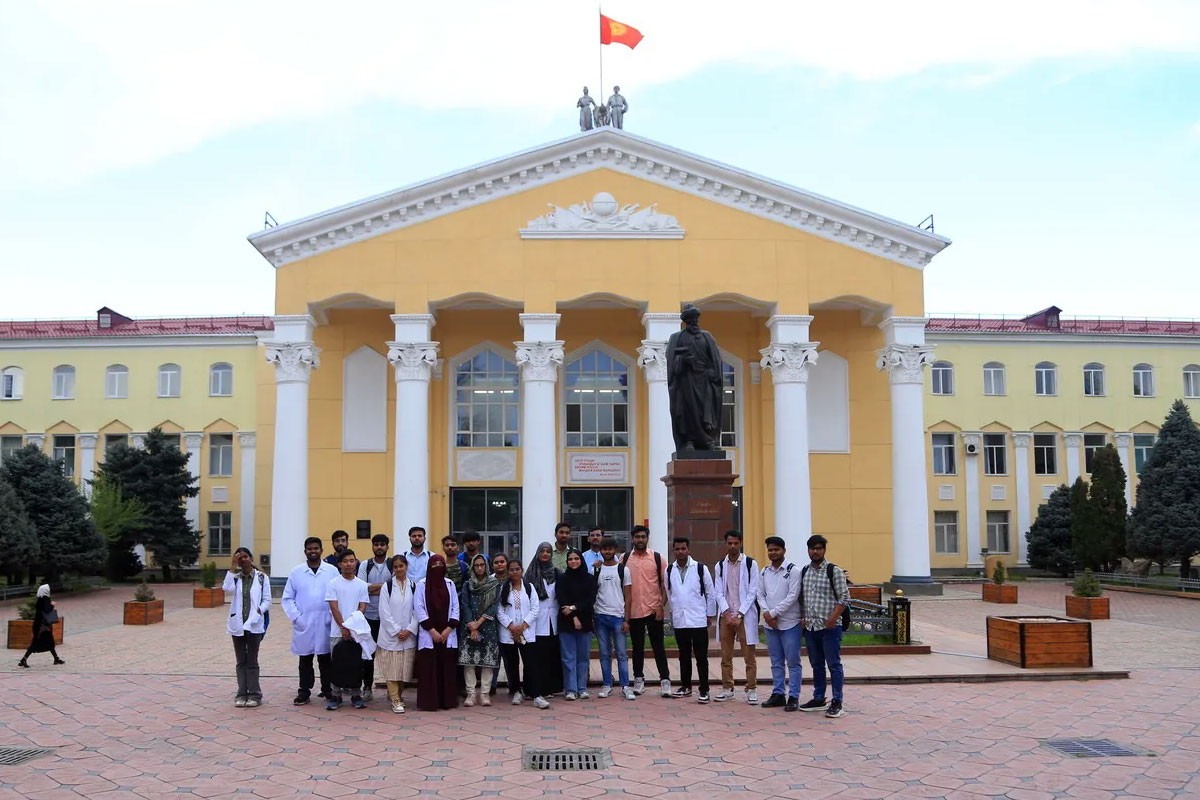
Meet Deepika Kumari. She is from Patna, Bihar. After qualifying NEET in her second attempt, she joins Kyrgyz Russian Slavic University (KRSU) in Bishkek, Kyrgyzstan — one of the most respected medical universities in Central Asia and the only Russian-Kyrgyz joint university in the region, established by an inter-governmental agreement between Russia and Kyrgyzstan.
Deepika spends six years in Bishkek. She learns to navigate the city’s trolleybuses. She survives Kyrgyz winters. She masters Russian medical terminology well enough to argue with her clinical supervisor about a differential diagnosis in Year 5. She does rotations at the National Hospital of Kyrgyzstan. By the time she is in Year 6, something has shifted.
Bishkek has become home. Her circle of friends — Kyrgyz, Russian, Kazakh, Indian — is here. The hospital where she does her rotations has hinted at a position. The city’s private medical sector is growing fast. She starts thinking about a question she never thought she would ask:
“What if I don’t go back to India? What if I become a doctor here — in Kyrgyzstan — and build my career in the country where I trained?”
This article answers that question completely — from the day she graduates from KRSU to the day she walks into a polyclinic in Bishkek as a licensed doctor under Kyrgyz law. We will cover every step: the mandatory Internatura (Kyrgyzstan’s compulsory clinical internship year), the Attestation Exam that leads to her Certificate of Specialist, the work permit process, and what her career can look like once she is licensed.
One important note before we begin: Kyrgyzstan’s medical licensing system is distinct from Russia’s, even though KRSU is a joint Russian-Kyrgyz institution. Russia replaced its old internship system with a new Accreditation model in 2017. Kyrgyzstan, as of 2026, still follows the traditional Internatura pathway. Understanding this difference is the first step.
If you studied at a Russian university, you do Primary Accreditation (3-stage exam — no internship year required). If you studied at KRSU or another Kyrgyz university, you do Internatura (1 full year of clinical internship) first, then the Attestation Exam. Two countries, two pathways.
Quick Reference: What Deepika Needs at a Glance
← Scroll to see full table →| Parameter | Details | Applies To |
|---|---|---|
| Degree at KRSU | Diploma of Specialist in General Medicine (6 Years, Russian medium) | All KRSU General Medicine graduates |
| Mandatory After Graduation | Internatura — 1-Year Clinical Internship (still required in Kyrgyzstan, unlike Russia) | All graduates before receiving a license |
| Licensing Process | Attestation Exam + Certificate of Specialist (Sertifikat Spetsialista) issued by Ministry of Health | Required for independent practice in any KG healthcare facility |
| License Validity | 5 years, renewable through periodic re-attestation | All licensed doctors in Kyrgyzstan |
| For Foreign Nationals | Work Permit from State Migration Service of Kyrgyzstan + Ministry of Health registration | Indian graduates and all non-KG citizens |
| Official Languages | Russian (primary in Bishkek/urban hospitals) + Kyrgyz (essential for rural areas) | All practicing doctors |
| Specialization Path | Rezidenatura — 2 to 3 years depending on specialty (Cardiology, Surgery, Pediatrics, etc.) | After Certificate of Specialist, for those wanting a specialty |
| Governing Ministry | Ministry of Health of the Kyrgyz Republic (Minzdrav KR) — minzdrav.gov.kg | Regulates all medical licensing, training, and standards |
Understanding Kyrgyzstan’s Medical Licensing System
Before diving into steps, let us understand how the Kyrgyz Republic organizes its healthcare and medical licensing — because it has features that surprise many Indian students who are more familiar with either the Indian or the Russian system.
The Kyrgyz Healthcare System: A Brief Overview
Kyrgyzstan’s healthcare system is structured around a tiered public network: primary care polyclinics (ambulatornye uchrezhdeniya), district hospitals (rayonnye bolnitsy), city hospitals (gorodskie bolnitsy), and national specialized centres. At the top sits the National Hospital of Kyrgyzstan in Bishkek — the country’s largest and most equipped tertiary care centre, where KRSU students do significant portions of their clinical training.
The Ministry of Health of the Kyrgyz Republic (Minzdrav KR) governs all medical licensing, training, and standards. All licensed doctors must be registered in the Ministry of Health’s national medical workers database. The Ministry also oversees the Attestation Commissions that examine and license new graduates.
The Internatura System — Kyrgyzstan’s Mandatory Bridge Year
Think of Internatura as the bridge between being a medical student and being a practicing doctor. Here is the best way to understand it with an analogy:
Example: Imagine you have just passed your driving theory test. You know all the rules. But before you can legally drive alone on public roads, you must complete a mandatory supervised driving period with an instructor. Internatura is exactly this — a mandatory supervised clinical practice year where Deepika transitions from guided student to semi-independent junior doctor, under formal supervision, in a real hospital environment.
During Internatura, Deepika is officially called an Intern (Интерн). She has a supervising doctor (Nastavnik — scientific mentor) assigned to her. She works real clinical hours, sees real patients, writes real prescriptions (countersigned by her supervisor), and maintains a formal Internatura Diary (Dnevnik Internatura) that records every case, procedure, and clinical encounter. This diary is a legal document that must be submitted at the end of the year.
Internatura in Kyrgyzstan is NOT the same as the casual ‘internship’ students do in Years 4–6 of the MBBS program. It is a separate, formal, government-regulated post-graduation program. Deepika must apply for it as a fresh graduate. It typically lasts exactly 12 months and cannot be shortened.
KRSU’s 6-year General Medicine program is one of the strongest in Central Asia. Established in 1993 by an inter-governmental agreement between Russia and Kyrgyzstan, KRSU operates on Russian educational standards and its diploma carries recognition in both countries. Teaching is in Russian throughout.
The curriculum follows FGOS (Federal State Educational Standards, Russian edition) with adaptations for the Kyrgyz Republic’s health priorities. Years 1–3 cover pre-clinical sciences (Anatomy, Physiology, Biochemistry, Histology, Pathological Anatomy, Pharmacology). Years 4–6 are clinical — Deepika spends her days in hospital wards, outpatient clinics, operating theatres, and delivery rooms at KRSU’s affiliated institutions.
KRSU’s Clinical Training Hospitals — Deepika’s Classrooms in Years 4–6
- National Hospital of Kyrgyzstan (Natsionalniy Gospital) — the flagship tertiary teaching hospital. Deepika sees complex, referral-level cases here.
- City Clinical Hospital No. 1 and No. 2, Bishkek — major urban hospitals where most of the high-volume general medicine, surgery, and emergency work happens.
- Republican Centre for Cardiovascular Surgery — cardiology and cardiac surgery rotations.
- Scientific Centre of Obstetrics, Gynaecology and Perinatology — OB-GYN and neonatal training.
- City Children’s Clinical Hospital — Paediatrics rotations.
What Deepika Should Focus on in Years 5–6 for Internatura and Attestation Preparation
- Maintain her Internatura readiness by actively treating every Year 6 rotation as a dry run — write proper case notes in Russian, present patients to supervisors formally, practice physical examination sequences in the correct order.
- Begin collecting attestation past papers from KRSU’s library. Past papers from the Ministry of Health Attestation Commission are often circulated among final-year students. These are the exact question styles she will face.
- Build her Internatura network — talk to Year 6 seniors who have just begun Internatura and ask which hospitals offer the best supervision. A good Nastavnik (mentor) makes all the difference.
Here is something many people outside Kyrgyzstan do not realise: Kyrgyzstan has two official state languages — Kyrgyz and Russian. But in the medical world, particularly in Bishkek and urban hospitals, Russian is the dominant language. Patient records are written in Russian. Prescriptions are in Russian. Medical conferences and journal publications are in Russian. The Attestation Exam is in Russian.
Since KRSU teaches entirely in Russian, Deepika will already have 6 years of Russian-medium education behind her. This is one of her greatest assets. But there are two layers she needs to be aware of:
Layer 1: Clinical Russian (The Language of Hospitals)
Medical Russian goes beyond conversational Russian. It includes thousands of specialist terms — organ names in Latinized Russian form, disease names, drug names, procedure names, ICD-10 diagnosis codes in Russian. Deepika needs to:
- Write a complete patient history (Istoriya Bolezni) in formal medical Russian — complaints (Zhalobyi), past history (Anamnez bolezni), family history, systems review, objective findings, diagnosis, treatment plan, discharge summary.
- Write prescriptions (Retsept) correctly — including drug name, dosage, route, frequency, duration, in standard Russian prescription format.
- Dictate or write referral letters (Napravleniye) to specialists — in correct Russian bureaucratic-medical style.
- Understand and interpret Russian-language lab reports, imaging reports, and specialist consultations.
Layer 2: Kyrgyz Language (For Rural and Regional Practice)
If Deepika intends to practice only in Bishkek, Russian alone is sufficient for her patient interactions. However, if she ever considers working outside Bishkek — in rural areas of Kyrgyzstan, in regional hospitals like those in Osh, Jalal-Abad, or Naryn — she will encounter patients who speak primarily Kyrgyz and have limited Russian. In these settings, at minimum a basic conversational Kyrgyz is essential.
During Internatura, deliberately choose at least one rotation at a district or regional hospital outside central Bishkek if possible. Even one month in a Kyrgyz-dominant setting will expose you to patient interactions in Kyrgyz and build the language foundation you need for broader career opportunities.
This is the most distinctive step in the Kyrgyz pathway — and the one that most sets it apart from Russia’s current system. Internatura is not optional. It is not abbreviated. Every graduate of every Kyrgyz medical university must complete it before they can take the Attestation Exam or receive a medical license.
Let us think of Internatura from Deepika’s practical perspective. She graduates from KRSU in June 2025. By early July, she was assigned to City Clinical Hospital No. 2 as an Intern. She has a white coat with ‘Intern’ on her badge. She has a Nastavnik — a senior doctor who is responsible for her. For the next 12 months, this is what her days look like.
How Internatura Is Structured at KRSU’s Affiliated Hospitals
The 12-month Internatura is divided into departmental rotations. While exact timings can vary by hospital, a typical structure for General Medicine Internatura looks like this:
← Scroll to see full table →| Department | Duration & Focus | Key Skills You Will Develop |
|---|---|---|
| Internal Medicine (Terapiya) | 3 months — hypertension, diabetes, respiratory diseases, gastroenterology. Daily ward rounds and patient management. | Taking a structured Russian-language patient history; writing discharge summaries (vypiski); interpreting ECG, blood tests, chest X-rays. |
| Surgery (Khirurgiya) | 2 months — surgical wards, pre- and post-operative care, basic wound management, surgical assisting. | Pre-operative patient assessment, suturing, sterile technique, writing operative notes in Russian. |
| OB-GYN (Akusherstvo) | 2 months — antenatal care, normal delivery assistance, gynaecological consultations. | Delivery room protocol, foetal heart monitoring, gynaecological examination, perinatal record keeping. |
| Paediatrics (Pediatriya) | 2 months — newborn ward, child outpatient consultations, vaccination schedules. | Paediatric dosage calculations, growth and development assessment, neonatal emergency management. |
| Emergency Medicine | 1 month — emergency department rotations, on-call night duty, acute care management. | Rapid assessment protocols, CPR and resuscitation, acute poisoning and trauma management. |
| Polyclinic (Outpatient) | 2 months — district physician work: outpatient consultations, referrals, preventive care, home visits. | GP-level primary care, prescription writing, sick leave certification, patient follow-up documentation. |
The Internatura Diary — Your Most Important Document
Everything Deepika does during Internatura goes into her Dnevnik Internatura (Internatura Diary). This is a formal, physically bound document issued by the Ministry of Health or KRSU. Every week, she must record:
- Number and types of patients seen that week — diagnoses, age, sex.
- Procedures performed — injections, cannulations, suturing, wound dressing, etc. — with dates.
- On-call duties completed.
- Complicated or interesting cases — brief case summaries in Russian.
- Supervisor’s weekly countersignature and evaluation remarks.
At the end of each rotation, the department head writes a formal rotation summary and signs off. At the end of 12 months, the entire diary plus the supervisor’s final Kharakteristika (character and competency assessment) is submitted to the Attestation Commission.
The Internatura Diary is a legal document and is taken very seriously by the Attestation Commission. Gaps in weekly entries, missing countersignatures, or a poor supervisor evaluation can delay your Attestation application. Treat it with the same seriousness you would treat your Diploma.
Internatura Salary and Status
During Internatura, Deepika is paid a modest stipend — typically around 8,000 to 15,000 Kyrgyz Som per month (approximately Rs. 7,000 to Rs. 13,000). This is low, but it is income. More importantly, she is covered by the hospital’s insurance, has access to the canteen, and — crucially — is building the clinical log that will be essential for her Attestation application. Some hospitals, particularly private ones, pay Interns better to attract candidates.
Not all hospitals offer equally good Internatura supervision. Choose a hospital with a strong reputation in your Nastavnik allocation. Ask at KRSU’s Postgraduate Department which hospitals have the most experienced supervising doctors and the highest Intern pass rates at Attestation. A proactive approach here pays dividends 12 months later.
After completing 12 months of Internatura, Deepika applies for the Attestation Exam (Attestatsiya) conducted by the Ministry of Health’s Attestation Commission. This exam, when passed, results in the issuance of the Certificate of Specialist (Sertifikat Spetsialista) in General Medicine — her official medical license in the Kyrgyz Republic.
The Attestation Exam has three parts, and all three must be passed. Let us walk through each one like her clinical supervisor would explain it to her before the exam.
← Scroll to see full table →| Component | What It Involves | How to Prepare |
|---|---|---|
| Part 1 — MCQ Test | Written multiple-choice examination covering the entire General Medicine curriculum: Internal Medicine, Surgery, OB-GYN, Paediatrics, Pharmacology, Public Health. Typically 100 questions. Conducted in Russian. Passing score: approximately 70%. | Solve previous years’ attestation question papers available at KRSU’s library and medical faculty office. Use Russian medical textbooks for revision — Komarov’s Internal Medicine, Savelyev’s Surgery, and Savel’yeva’s OB-GYN are standard references used in Kyrgyz attestation. |
| Part 2 — Practical Skills | Assessment of clinical practical skills. You will be asked to demonstrate procedures on a mannequin or describe step-by-step protocols: CPR, IV access, wound care, patient examination sequence. Examiner evaluates technique and narration in Russian. | Practice all standard procedures repeatedly during your Internatura rotations. Request your Internatura supervisors to formally assess your practical skills at least once per department rotation. This builds confidence and corrects technique early. |
| Part 3 — Oral Viva | Face-to-face oral examination with a panel of examiners from the Ministry of Health Attestation Commission. You receive a clinical scenario (bilet — examination card) and must discuss diagnosis, differential diagnosis, treatment plan, and preventive measures. All in Russian. | This is where most students either shine or struggle. Practice presenting clinical cases out loud — alone or with classmates — entirely in Russian. Use the format: Zhalobyi (Complaints) → Anamnez (History) → Obektivny Status (Examination) → Diagnosis → Lechenie (Treatment). This structure is what examiners expect. |
| Result | Pass all three parts → Issued Certificate of Specialist (Sertifikat Spetsialista) in General Medicine by the Ministry of Health Attestation Commission. | Fail any part → Retake that specific part in the next attestation window (usually 3–6 months later). Partial passes are retained. |
Example: Deepika’s Oral Viva bilet reads: A 52-year-old male patient, smoker, complains of chest pain radiating to the left arm, 30 minutes duration, sweating, nausea. ECG shows ST elevation in leads II, III, aVF. Her response: “Predvaritelniy diagnoz — Ostry Infarkt Miokarda, nizhnyaya stena levogo zheludochka, pervichniy, s podemom segmenta ST. Kod ICD-10 — I21.1. Taktika: neotlozhnaya gospitalizatsiya v otdeleniye intensivnoy terapii, ASA 325 mg, geparinizatsiya, ECG monitoring, konsultatsiya kardiokhirurga dlya reshenie voprosa o PCI.” The examiners nod. She has used the correct format, the right ICD code, and the appropriate emergency management pathway. She passes.
After Passing: Receiving the Certificate of Specialist
The Attestation Commission issues the Sertifikat Spetsialista within 10–15 working days of the exam. This certificate:
- Is issued in Russian and Kyrgyz languages (bilingual document).
- Specifies the specialty: General Medicine (Lechebnoe Delo).
- Is valid for 5 years, renewable through Periodic Re-Attestation.
- Is recognized at all licensed healthcare institutions across the Kyrgyz Republic.
- Serves as the legal basis for Deepika’s work permit application as a foreign national doctor.
Once the Certificate of Specialist is issued, Deepika must be entered into the Ministry of Health’s official Registry of Medical Workers. This is the national database that hospitals use to verify that a doctor is legitimately licensed. When a hospital’s HR department checks a doctor’s credentials, this registry is their first stop.
How Registration Works
1. Automatic Registration — In many cases, the Attestation Commission registers newly certified doctors in the Ministry of Health database as part of the certification process. Confirm with the Commission that this step has been completed for your record.
2. Manual Registration — If not automatically registered, visit the Ministry of Health’s human resources department in Bishkek with your Certificate, Diploma, and passport. Registration is straightforward and typically same-day.
3. Tax and Social Fund Registration — Deepika also needs a Kyrgyz Tax Identification Number (INN) and Social Fund registration (Sotsialni Fond). These are required for employment payroll. Both can be obtained from the respective government offices in Bishkek.
Complete your Tax (INN) and Social Fund registration during Internatura — you already need these for your Intern stipend payments. Having them sorted early means zero delay after your Attestation Certificate is issued.
This step is unique to Deepika as an Indian citizen. Kyrgyz nationals with a Certificate of Specialist can walk directly into any hospital and start working. Deepika needs one additional layer of authorization: a Work Permit from the State Migration Service of Kyrgyzstan.
Here is the important distinction: a student visa does not permit Deepika to work as a doctor. After graduation, she transitions from student status to professional status. That transition requires a deliberate immigration action.
The Work Permit Process
1. Secure a Job Offer or Letter of Intent — Most hospitals will initiate a Work Permit application only after seeing your Certificate of Specialist. However, a Letter of Intent from a hospital during late Internatura can help start the paperwork early. Deepika should approach private clinics and polyclinics in Bishkek before her Attestation exam — many actively recruit soon-to-be-certified doctors.
2. Employer Submits Work Permit Application — The employing hospital or clinic submits a Work Permit application to the State Migration Service of the Kyrgyz Republic (migration.gov.kg) on Deepika’s behalf. Required documents from Deepika: passport, Certificate of Specialist, Diploma, photos, and proof of residence registration in Bishkek.
3. Processing Time — Typically 15–25 working days. Plan accordingly — do not allow your student visa status to lapse before the work permit is issued.
4. Visa Status Transition — Simultaneously, Deepika’s visa status must be updated from Student (Uchebnaya Viza) to Worker (Trudovaya Viza). Her employer’s legal department or a registered visa agency in Bishkek handles this. This is routine and well-understood by HR departments at hospitals that have hired foreign graduates before.
Long-Term Options: Temporary Residence and Permanent Residency
After working in Kyrgyzstan for 1 year on a Work Permit, Deepika becomes eligible to apply for a Temporary Residence Permit (Vremennoe Prozhivaniye), which gives her the right to live and work without an annual Work Permit renewal. After 5 years of legal residence, she may apply for Permanent Residency. These long-term options simplify her administrative life considerably and many foreign medical graduates in Kyrgyzstan pursue them.
Do not let your student visa expire between graduation and Work Permit issuance. Overstaying a visa in Kyrgyzstan carries fines and can complicate future immigration applications. Start the visa transition process at least 2 months before your graduation date. Kyrgyzstan’s State Migration Service is generally accessible and responsive, but do not leave this to the last minute.
With her Certificate of Specialist and Work Permit in hand, Deepika is now Dr. Deepika Kumari — a fully licensed General Practitioner in the Kyrgyz Republic. Here is what her career options and daily life look like.
Where Can Deepika Work?
- Government Polyclinics (Poliklinika) — Primary care clinics serving assigned residential districts. Stable hours, predictable workload, modest pay. The most common starting point for new graduates.
- City and National Hospitals — As a Ward Doctor (Vrach Otdeleniya) or Junior Doctor in Internal Medicine, Surgery, or other departments. More clinical complexity, longer hours, better exposure for future Rezidenatura applications.
- Private Medical Clinics in Bishkek — Bishkek’s private healthcare sector is growing rapidly. Clinics like Medical Centre ‘Altyn Medline’, ‘Bona Vita’, ‘European Medical Centre’, and others actively hire licensed GPs. Pay is significantly better than public sector.
- International and NGO Medical Programmes — Organizations like ICRC, MSF (Médecins Sans Frontières), WHO’s Kyrgyzstan office, and various health development NGOs periodically recruit licensed local doctors. These positions typically require English proficiency in addition to Russian.
- KRSU Teaching Faculty (Junior Lecturer / Demonstrator) — After 2–3 years of clinical experience, Deepika can apply for a part-time teaching role at KRSU. English-Russian bilingual doctors with clinical experience are valued in university departments.
What Does a Typical Day Look Like for Deepika at a Bishkek Polyclinic?
- 8:00 AM: Morning handover meeting — outpatient schedule review, any urgent home visit requests.
- 8:30 AM – 2:00 PM: Outpatient consultations — 15–20 patients scheduled at 15-minute slots. Common presentations: hypertension, Type 2 diabetes, upper respiratory infections, musculoskeletal pain, mental health counseling.
- 2:00 PM – 3:00 PM: Documentation — updating electronic patient records, writing referral letters, signing sick leave certificates (Bolnichniy List).
- 3:00 PM – 5:00 PM: Home visits (Vyezdy na Dom) for elderly, post-operative, or disabled patients who cannot attend the clinic.
- On-call shifts: Periodic evening or weekend duty at the polyclinic’s emergency reception room.
Salary Reality in 2026
Public sector salary for a newly licensed GP in Bishkek: 28,000 to 55,000 Kyrgyz Som per month (approximately Rs. 24,000 to Rs. 47,000). Private clinic salary: 70,000 to 150,000 Som per month (approximately Rs. 60,000 to Rs. 1.3 Lakh). Kyrgyzstan’s cost of living is significantly lower than Indian metro cities — a comfortable one-bedroom apartment in central Bishkek costs 20,000 to 35,000 Som per month in rent. Food, transport, and daily expenses are affordable. The net purchasing power of Deepika’s salary in Bishkek is comparable to a mid-level position in an Indian private hospital.
Many experienced Indian doctors in Kyrgyzstan work a morning shift in a government hospital (which provides them Ministry of Health registration and legal status) and a private clinic shift in the afternoon. This dual employment structure, which is legal and common in Kyrgyzstan, significantly increases total income while maintaining institutional affiliation.
If Deepika discovers during Internatura that she has a passion for, say, Cardiology or Paediatrics, she can pursue specialization through Rezidenatura — Kyrgyzstan’s post-graduate residency program.
How Rezidenatura Works
- Entry Requirement: Certificate of Specialist in General Medicine + competitive entrance examination in your chosen specialty.
- Duration: 2 years for most clinical specialties (Cardiology, Neurology, Psychiatry, OB-GYN, Paediatrics, Internal Medicine subspecialties). 3 years for Surgery and its subspecialties.
- Venues: Rezidenatura is conducted at KRSU, Kyrgyz State Medical Academy (KSMA), or the National Hospital of Kyrgyzstan’s educational departments.
- Funding: Budget-funded (free) seats go to top entrance exam scorers. Contract (paid) seats are available to all qualifying applicants.
- Outcome: After completing Rezidenatura, the doctor undergoes a Final Certification Exam and receives a Specialist Certificate in the chosen specialty.
Example: Deepika works as a GP in Bishkek for 18 months after her Attestation. During this time, she notices that many of her patients have cardiovascular disease and she finds herself deeply engaged by cardiology cases. She applies for Rezidenatura in Cardiology at KRSU. She passes the entrance exam. Over 2 years, she trains under senior cardiologists at the Republican Centre for Cardiovascular Surgery. In 2029, she is Dr. Deepika Kumari, Cardiologist — one of the few Indian women specialists practicing cardiology in Central Asia.
Complete Documents Checklist: Every Paper Deepika Needs
Bureaucratic preparedness is not exciting — but it is what separates a smooth path from a frustrating one. Every document below serves a specific purpose at a specific stage of Deepika’s journey.
← Scroll to see full table →| Category | Document | Where to Get It |
|---|---|---|
| Academic | Diploma of Specialist in General Medicine (Russian + Kyrgyz versions) | KRSU Academic Registrar — issued on graduation |
| Academic Transcript / Supplement to Diploma (Prilozhenie k Diplomu) | KRSU Academic Registrar | |
| Internatura Completion Certificate (Svidetestvo ob Internature) | Internatura host hospital / KRSU postgraduate office | |
| Internatura Diary (Dnevnik Internatura) — log of all cases and procedures | Maintained by you throughout Internatura; certified by supervisor | |
| Identity | Valid Indian Passport (with current valid Kyrgyz visa or residence permit) | Indian Passport Office + Kyrgyz State Migration Service |
| Residence Registration (Propiska/Registratsiya) in Bishkek | Local Passport and Registration Service (UFMS equivalent in KG) | |
| Attestation | Application Form for Attestation Exam (available from Ministry of Health) | Ministry of Health Kyrgyz Republic — minzdrav.gov.kg |
| Supervisor’s Evaluation Report (Kharakteristika) from Internatura | Chief of your Internatura department / hospital | |
| Medical Health Book (Meditsinskaya Knizhka) — personal health record | City polyclinic or KRSU medical centre | |
| Work Permit | Work Permit Application for Foreign Specialists | State Migration Service of Kyrgyzstan (migration.gov.kg) |
| Certificate of Specialist (issued after passing Attestation) | Ministry of Health Attestation Commission | |
| Employment Contract / Letter of Intent from a Kyrgyz Healthcare Institution | Your employing hospital or clinic HR department | |
| Tax & Social | Tax Identification Number (INN) — Kyrgyz tax registration | State Tax Service of Kyrgyzstan |
| Social Fund Registration — for payroll deductions and pension | Social Fund of Kyrgyzstan (Sotsialni Fond) |
Documents issued by KRSU (Diploma, Transcripts) are already Kyrgyz-state documents and do not need apostille for use within Kyrgyzstan. If Deepika ever needs to use them in India (for NMC registration or FMGE/NExT) or in a third country, she will need an apostille and certified translation. The apostille is obtained from the Ministry of Justice of the Kyrgyz Republic.
Complete Timeline: From KRSU Graduation to Licensed Practice
← Scroll to see full table →| When | What to Do |
|---|---|
| Year 5 — Early | Start collecting attestation past papers. Identify which KRSU-affiliated hospital you want to complete your Internatura in. Speak to Year 6 seniors who have gone through the process. |
| Year 6 — Internship | Complete your final-year clinical internship at KRSU’s affiliated hospitals (National Hospital, City Clinical Hospital, Bishkek). Focus on clinical documentation and Russian-language case presentations. |
| Graduation Month | Collect your Diploma of Specialist in General Medicine. Apply for Internatura placement immediately — Internatura typically starts within 1–2 months of graduation. Submit documents to KRSU’s postgraduate office. |
| Months 1–12 Post-Graduation | Complete 1-year Internatura at a Ministry of Health-approved teaching hospital. Rotate through all departments. Maintain Internatura diary (dnevnik internatura) — a log of all cases and procedures. This diary is submitted at the end of Internatura. |
| End of Internatura | Internatura supervisor submits your evaluation report. You apply to the Ministry of Health Attestation Commission for the Attestation Exam. Gather all required documents. |
| Attestation Month | Appear for the 3-part Attestation Exam: MCQ Test, Practical Skills Assessment, Oral Viva. Typically conducted at the Ministry of Health or a designated medical institution in Bishkek. |
| 1–2 Weeks After Passing | Receive Certificate of Specialist in General Medicine. Register with the Ministry of Health’s medical workers database. Begin work permit application if not already initiated. |
| Month 14–16 | Obtain Work Permit from the State Migration Service. Confirm registration with Bishkek Social Fund (Sotsialni Fond) for payroll. Begin applying to hospitals, polyclinics, or private clinics. |
| Month 16–18 | Start practicing as a licensed General Practitioner (Vrach-Terapevt or Vrach Obshchey Praktiki) at your chosen healthcare facility in Kyrgyzstan. |
| Every 5 Years | Periodic Re-Attestation. Submit evidence of continuing medical education (CME), updated clinical log, and appear for refresher assessment to renew Certificate of Specialist. |
Career Choice: GP Practice vs. Rezidenatura Specialization
← Scroll to see full table →| Parameter | Practice as GP Directly | Enter Rezidenatura (Specialization) |
|---|---|---|
| Start Date | Immediately after Certificate of Specialist + Work Permit (approx. 15–18 months post-graduation) | After Certificate of Specialist — apply for competitive Rezidenatura entrance exam |
| Duration | Can work indefinitely as Vrach-Terapevt / Vrach Obshchey Praktiki | 2 years (most specialties) to 3 years (Surgery, Neurosurgery) |
| Salary Range | 25,000–60,000 Kyrgyz Som/month in public sector. Up to 100,000+ in private Bishkek clinics. | Stipend during Rezidenatura (modest). Significantly higher salary after specialist license. |
| Career Ceiling | General Practice / Primary Care / District Physician | Cardiologist, Surgeon, Neurologist, OB-GYN Specialist, Paediatrician, etc. |
| Competition for Entry | Low to Moderate — GP positions widely available, especially outside Bishkek | Moderate to High — limited seats, competitive exam, popular specialties fill fast |
| Private Clinic Opportunity | Yes — private clinics in Bishkek actively hire GPs | Yes — specialist positions in private hospitals pay significantly more |
| Recommended For | Students who want to start earning immediately, gain experience, or who genuinely enjoy primary care medicine | Students committed to a specific clinical specialty and financially prepared for 2–3 more years of study |
Work as a GP for at least one year before deciding on Rezidenatura. Internatura shows you the breadth of medicine. One year of GP practice reveals which specialty pulls at you most strongly. Many of Kyrgyzstan’s best specialists entered Rezidenatura after a year or two of clinical work — and their practical maturity made them far stronger residents than those who entered immediately after Internatura.
Keeping the License: Periodic Re-Attestation Every 5 Years
Deepika’s Certificate of Specialist is valid for 5 years. Before it expires, she must undergo Periodic Re-Attestation (Periodicheskaya Attestatsiya). Unlike the initial post-Internatura exam, this is less about testing from scratch and more about demonstrating continued competence and professional development.
What Periodic Re-Attestation Requires
1. CME Portfolio — Deepika must document her continuing medical education — conferences attended, courses completed, seminars, workshops. The Ministry of Health specifies a minimum number of CME hours per 5-year cycle (check current requirements at minzdrav.gov.kg for the latest figure).
2. Clinical Activity Log — A log of her clinical work over the 5 years — cases managed, procedures, referrals made, on-call duties. Many hospitals maintain this automatically through electronic patient record systems.
3. Updated Competence Assessment — A written test and potentially a practical skill check, administered by the Re-Attestation Commission. The format is less intensive than the initial Attestation but must still be passed.
4. Certificate Renewal — Upon successful completion, her Certificate of Specialist is renewed for another 5 years. This cycle continues throughout her career.
The continuing education (CME) requirement is designed to be manageable alongside regular clinical work. Attending one major medical conference per year and completing a relevant online course every 6 months is generally sufficient to meet the requirement. KRSU and KSMA regularly offer postgraduate CME courses that count toward the certificate renewal cycle.
Frequently Asked Questions
No. Graduating from KRSU gives Deepika her academic qualification — the Diploma of Specialist in General Medicine. But practicing medicine requires a license. To get that license, she must complete a mandatory 1-year Internatura (clinical internship) and then pass a formal Attestation Exam conducted by the Ministry of Health. Only after passing the Attestation does she receive the Certificate of Specialist, which is her medical license in Kyrgyzstan.
Russia replaced Internatura with Primary Accreditation in 2017 as part of a major healthcare reform. Kyrgyzstan, while closely connected to Russia’s medical education system (especially through universities like KRSU), follows its own healthcare legislation. As of the current period, Kyrgyzstan’s Ministry of Health still mandates 1-year Internatura as a compulsory post-graduation step before independent practice. Always check current regulations at minzdrav.gov.kg, as policies can evolve.
KRSU has official Internatura placement arrangements with several hospitals in Bishkek, including the National Hospital of Kyrgyzstan, City Clinical Hospitals No. 1 and No. 2, and several specialized centres. The KRSU Postgraduate Department handles Internatura placements for its graduates. Deepika should contact this department as early as Year 6 to secure her preferred department rotation. Self-arranged Internatura at non-affiliated hospitals is generally not accepted — the hospital must be Ministry of Health-approved for Internatura.
The Attestation Exam is conducted primarily in Russian. KRSU is a Russian-medium university, so Deepika will have been studying in Russian for 6 years — this is a significant advantage. The Oral Viva component (Part 3) specifically requires strong conversational and clinical Russian, as you must present cases, discuss diagnoses, and respond to examiner questions entirely in Russian. Some Kyrgyz language knowledge is beneficial for Part 3 if any examiner prefers to probe in Kyrgyz, but Russian is the dominant exam language.
Yes. Kyrgyzstan’s labour law permits foreign nationals to work in the country with a valid Work Permit (Razresheniye na Rabotu) issued by the State Migration Service. Foreign medical graduates who have studied at Kyrgyz universities and hold a Ministry of Health Certificate of Specialist are eligible to apply for a work permit, typically sponsored by the employing healthcare institution. Deepika retains her Indian citizenship throughout — she does not need to change nationality to work in Kyrgyzstan.
Salaries in Kyrgyzstan’s public healthcare sector range from approximately 25,000 to 60,000 Kyrgyz Som per month for a General Practitioner (equivalent to roughly Rs. 22,000 to Rs. 52,000). Private clinics in Bishkek pay significantly more — 80,000 to 150,000 Som/month for experienced GPs (approximately Rs. 70,000 to Rs. 1.3 Lakh). Specialist doctors with Rezidenatura qualifications earn even more. Compared to India’s private hospital salaries, these are competitive, especially given Kyrgyzstan’s lower cost of living.
Yes, but separately. KRSU’s diploma is recognized in Russia because KRSU is a joint Russian-Kyrgyz university established by an inter-governmental agreement. However, to practice in Russia, Deepika would still need to pass Russia’s Primary Accreditation system (Pervichnaya Akkreditatsiya) — the 3-stage exam. The Kyrgyz Certificate of Specialist and the Russian Accreditation Certificate are separate licenses issued by separate governments. Completing one does not automatically grant the other.
There are important differences. In Kyrgyzstan’s public hospitals, resources can be more limited than large Indian private hospitals. Diagnostic infrastructure varies significantly between Bishkek city hospitals (relatively well-equipped) and regional hospitals outside the capital (often under-resourced). The patient population in Bishkek is predominantly Russian-speaking; in rural Kyrgyzstan, Kyrgyz language becomes important. The medical culture is more hierarchical than in Western systems, with senior doctors (zaveduiushchiy otdeleniyem — department heads) playing a powerful mentorship and oversight role. For Deepika, a doctor trained at KRSU in Bishkek, the transition to Bishkek’s hospital environment will be smooth.
Several strong pathways exist. First, she can enter Rezidenatura for specialization — this is the most common advancement route. Second, she can teach at KRSU or other Kyrgyz medical universities — there is genuine demand for English and Russian-bilingual teaching doctors who have clinical experience. Third, after gaining 3–5 years of clinical experience, she may qualify for longer-term residence or even permanent residency in Kyrgyzstan. Fourth, with Kyrgyzstan experience and KRSU credentials, she can explore opportunities in other CIS countries like Kazakhstan or Belarus which have mutual recognition of medical qualifications within certain frameworks.
Kyrgyzstan is generally considered safe for foreign professionals including women. Bishkek is a modern, multicultural city with an established international community. KRSU’s campus area and central Bishkek are particularly safe and well-familiar to Indian students who have spent years there. As with any country, standard personal safety practices apply. The Indian Embassy in Bishkek provides consular support to Indian citizens. Deepika should register with the Embassy shortly after graduation and update her contact details as her visa status changes from student to worker.
Conclusion: Kyrgyzstan Is a Real Career Destination — Here Is Your Map
Let us return to Deepika’s story and see where it ends. She graduated from KRSU in June 2025. She completed her 12-month Internatura at City Clinical Hospital No. 2 in Bishkek, maintaining a meticulous Internatura Diary. She passed her Attestation Exam in all three parts — the MCQ in the morning, the practical station in the afternoon, and the Oral Viva with a panel of Ministry of Health examiners the following day.
Her Certificate of Specialist in General Medicine arrived 12 days later. Her Work Permit, sponsored by a private clinic in central Bishkek that had offered her a position, was issued two weeks after that. On September 15, 2026 — 15 months after graduating from KRSU — Dr. Deepika Kumari saw her first patient as a fully licensed doctor in the Kyrgyz Republic.
Her path was not fast. Internatura takes a full year — there are no shortcuts. The Attestation Exam is rigorous. The paperwork for a Work Permit requires patience. But every step is clearly defined, the system has a logical structure, and it has been navigated successfully by Indian graduates before her.
The key lessons from Deepika’s journey are simple:
- Start preparing for Attestation in Year 5 — not after graduation. Collect past papers early.
- Choose your Internatura hospital carefully — a strong Nastavnik makes the year genuinely educational, not just a formality.
- Maintain your Internatura Diary impeccably — it is a legal document and examiners take it seriously.
- Master clinical Russian — every part of the Attestation and daily hospital work demands it.
- Begin Work Permit paperwork during late Internatura — do not wait until after Attestation to start thinking about it.
- Think long-term — GP practice first, then Rezidenatura. Experience makes better specialists.
The road from Indian student to licensed Kyrgyz doctor is clear, structured, and achievable. Deepika walked it. With the right preparation and the right mindset, so can you.
Have questions about MBBS at KRSU or practicing medicine in Kyrgyzstan?
Visit MBBSDirect.com — India’s trusted advisor for MBBS abroad, helping students make informed decisions since day one.