Student Helpline! +91 9717172071
  Apply Here

The NEET Result — and the Decision That Followed
When my NEET 2024 result came — 392 out of 720 — I was not surprised, but I will not pretend it was easy. I had studied. I had tried. But a government medical college seat in India was out of reach at that score, and private colleges in India were asking for fees in crores that my family simply could not commit to.
So we made a decision — not out of desperation, but out of deliberate thinking: MBBS abroad was the path. The question was where. And that search became one of the most exhausting, confusing, and finally deeply satisfying experiences of my life.
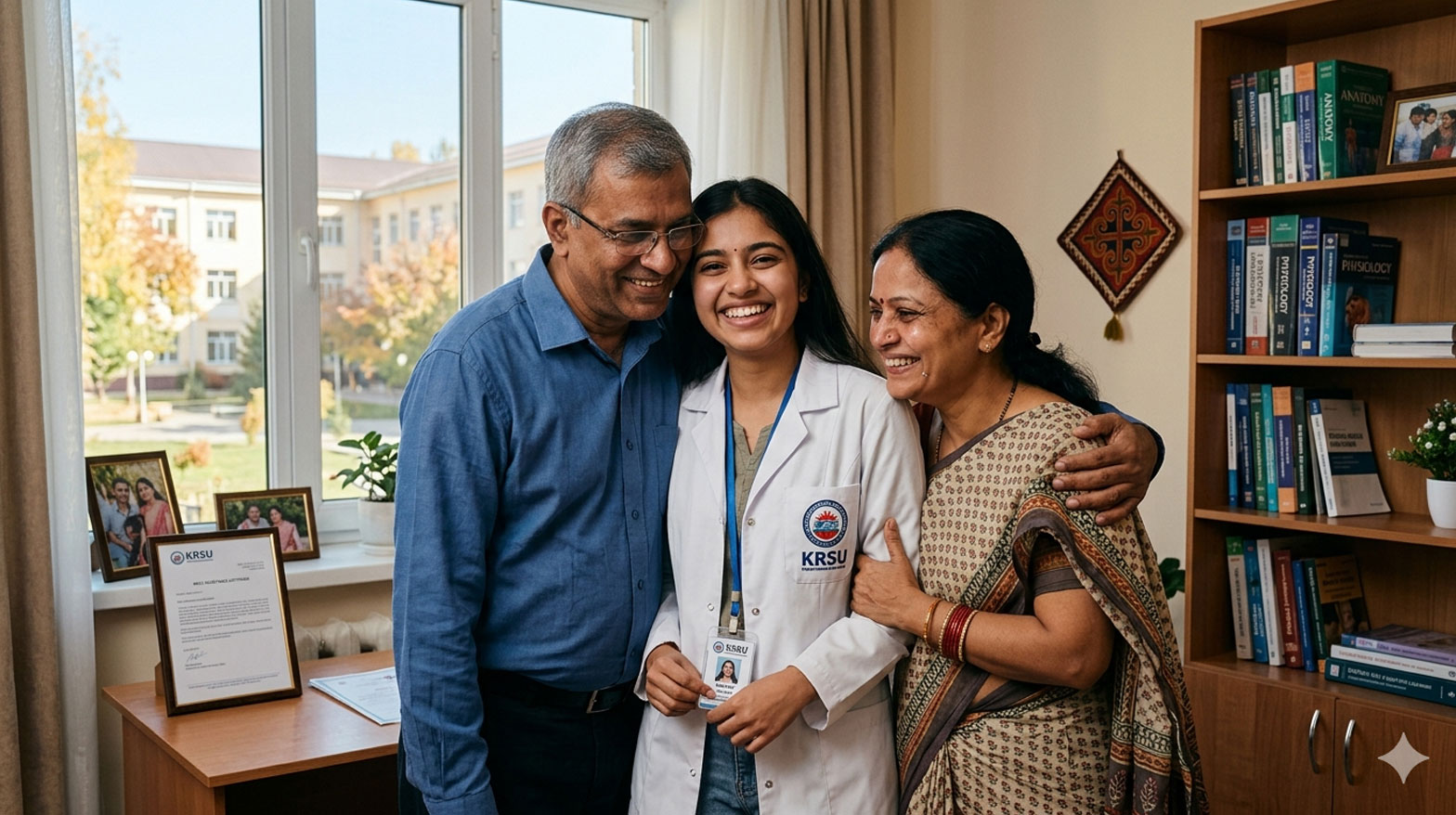
I am writing this sitting in Bishkek, in my second year at Kyrgyz Russian Slavic University (KRSU). I want to tell you exactly how we got here — every university we considered, every reason we moved on, and why KRSU and MBBSDirect ended up being the answer to every question my father had asked.
What My Father Said — Six Things He Would Not Compromise On
My father is not a man who makes emotional decisions. When we sat down to plan this, he said something that defined everything that followed:
That became our framework. Six non-negotiables — every university we evaluated had to answer all six:
What We Were Looking For
- Indian community — ideally a structured support system on campus
- Indian food available — reliably, not just “sometimes”
- Strong academic quality and clinical training
The Must-Haves
- Proven FMGE / NExT pass rate — data, not promises
- Good direct flight connectivity with India
- Politically stable country — no active conflicts, no realistic risk
Simple requirements. But as we started researching — visiting consultancies, watching YouTube videos, reading forums — we realised that finding a university that genuinely checked all six was not simple at all.
The Long List That Kept Getting Shorter — Universities We Considered
We spent weeks going through university after university. Here is exactly what we found — and why each one did not make it past our six criteria.
KSMA (Kyrgyz State Medical Academy) — Bishkek, Kyrgyzstan
Interestingly, KSMA is also in Bishkek — the same city as KRSU. It was one of the first names that came up in our Kyrgyzstan research. But when we dug deeper, we found that the university was admitting close to 500 Indian students in a single batch. That number alone raised questions — but what made it worse was that there was genuine confusion about which campus students would actually study in. Nobody could give us a clear answer. Feedback from current students was mixed — some had positive experiences, others did not. With that level of uncertainty in the same city as KRSU, there was no reason to choose it over a clearly better-proven option.
Why We Moved On: 500-student batch size, campus uncertainty, and inconsistent student feedback.
Kursk State Medical University — Russia
Kursk has a solid reputation and a significant Indian student presence. But Kursk is located very close to the Ukraine border — and the conflict that is actively ongoing in that region made this a non-starter for my family. No university ranking or fee structure is worth the risk of sending your child into a conflict-adjacent area.
Why We Moved On: Too close to the conflict zone. Risk not acceptable.
Altai State Medical University — Siberia, Russia
Altai came up as an affordable option. But it is located in Siberia — extreme cold, extreme isolation, and limited connectivity with India. Student feedback was inconsistent, and finding direct or convenient flights home was genuinely difficult. It just did not fit.
Why We Moved On: Location too remote. Mixed feedback. Poor connectivity.
Universities in Georgia
Georgia was appearing a lot in our research. The country is beautiful, the cost is reasonable, and universities there have been aggressive in marketing to Indian students. But we found a critical issue that no consultancy had mentioned upfront: the MBBS degree from Georgia is not recognised for Indian licensing unless the student also completes their PG from Georgia. That one fact ended the conversation entirely. Georgia was removed from the list immediately.
Why We Moved On: Degree not valid in India without PG from Georgia. Deal-breaker.
Universities in Uzbekistan
Uzbekistan has been promoted heavily as an emerging MBBS destination. But most universities there have limited experience in delivering MBBS in English — the ecosystem for Indian students, the Indian food, the alumni network, the structured support — simply is not there yet. If the budget allows up to ₹40 lakhs for a 6-year programme, there are significantly better-proven options available. Uzbekistan, at this stage in its development, felt like a gamble we were not willing to take.
Why We Moved On: Limited English MBBS experience. Better options available at similar budget.
Then We Found KRSU — and Everything Changed
Kyrgyz Russian Slavic University. The name was not immediately familiar. But once we started reading about it, we could not stop.
The FMGE Data That Stopped Us in Our Tracks
The first thing that stood out — and it stood out completely: KRSU has been among the top performers in FMGE results for MBBS abroad for six consecutive years. Now here is what made this genuinely remarkable — at the time of our research, only six Indian batches had passed out from KRSU. Six batches. And all six times, the FMGE performance had been outstanding.
Think about what that means. This is not a university that had one good year and marketed it for a decade. This is a pattern across every single batch that has appeared for the exam. Six for six. That is not luck. That is quality — in the curriculum, in the teaching, in how students are prepared.
Location — Bishkek, Kyrgyzstan
Bishkek is the capital of Kyrgyzstan — a modern, well-connected city. When we checked flight connectivity, we found regular, affordable direct and one-stop flights between India and Bishkek. Manas International Airport has good connections. Coming home for vacations, or having family visit, is genuinely manageable — not a logistical nightmare.
And politically: Kyrgyzstan is a stable country. There is no active conflict. There is no realistic risk of the kind of disruptions that have affected students in Ukraine or conflict-adjacent regions of Russia. My father specifically mentioned this when we told him. He visibly relaxed.
✓ What KRSU Checked
- FMGE — top performer, 6 consecutive years
- Bishkek — modern, safe capital city
- Good India flight connectivity
- Stable country — no active conflict
- Indian student community established
- Strong academic reputation
✗ What Others Couldn’t Offer
- Ukraine universities — active war zone
- Kursk — too close to Ukraine border
- Georgia — degree not India-valid without PG
- Altai — Siberia, poor connectivity
- Uzbekistan — limited English MBBS experience
- KSMA (Bishkek) — 500-student batch, campus confusion
The Detail That Sealed It — 6 Years of Student Care, Managed
Here is something that does not get talked about enough when students research MBBS abroad. What happens after you land? Who looks after you in Year 2 when your hostel has a problem? Who makes sure the Indian mess keeps running? Who do you call at 11pm when something goes wrong?
When we found out that KRSU had officially partnered with a consultancy to manage Indian student welfare for all 6 years — not just admissions, but ongoing, throughout the entire degree — that was a completely different level of commitment than anything else we had seen.
We dug further to find out which company this was. The answer: MBBSDirect.
The Google Reviews That Convinced My Father
I will be honest. By the time we found MBBSDirect, we had already met several consultancies. Some were pushy. Some were vague. Some seemed more interested in their commission than in what was right for our situation. We were skeptical.
But my father read through the Google reviews of MBBSDirect himself. Not just a few — he went through review after review. And what he found was not just positive ratings. It was specific feedback — parents writing about how their concerns had been addressed, students describing what daily life was actually like in Bishkek, families sharing exactly what to expect from the process. This is not the kind of content you can manufacture or fake.
Two Years Later — My Honest Verdict
I am now completing my second year at KRSU. Here is what I can tell you, honestly, without exaggeration:
| What We Expected | What We Found |
|---|---|
| Good academic quality | Rigorous, structured curriculum — FMGE-aligned and genuinely demanding in the right way |
| Indian food available | Indian mess is running. It has been a genuine lifesaver, especially in the first few months |
| Safe country and city | Bishkek is safe. I have never felt uncomfortable or at risk in two years |
| Indian support on campus | MBBSDirect is present, responsive, and accountable — the kind of support that matters when you are 4,000 km from home |
| FMGE preparation | The curriculum is clearly designed with FMGE in mind. I feel prepared, not anxious |
| Peace of mind for my family | My father calls every few days — not to check if I am okay, just to chat. That says everything. |
Questions Students Ask Me — Answered Honestly
My Bottom Line — For Students and Families Reading This
We were thorough. We did not rush. We asked hard questions and crossed universities off the list even when they looked attractive on the surface. KSMA (Kyrgyz State Medical Academy, Bishkek) had too many students in one batch and a confused campus situation. Kursk was too close to a war. Georgia had a degree recognition problem nobody mentioned upfront. Altai was Siberia. Uzbekistan was too early in its journey.
KRSU answered every question. Six years of outstanding FMGE results. A capital city that is modern and safe. Good flights home. Indian food. And MBBSDirect — a company that had earned trust through hundreds of consistent, specific, detailed reviews from real families.
If I had to make this decision again tomorrow, I would make the exact same one. — Sarvan Ramakrishnan, 2nd Year MBBS, KRSU Bishkek