Student Helpline! +91 9717172071
  Apply Here




Kazan State Medical University (KSMU)
An Overview of University
| University Type : | Public (Government) — Ministry of Health, Russia |
| Founded : | 1814 — over 210 years; third oldest medical university in Russia after Moscow & Saint Petersburg |
| Historical Rank : | Ranked 3rd among Russian medical universities (ARES European Standard) |
| English-Medium Since : | 1996 — 30+ years; one of Russia's earliest English-medium MBBS programmes |
| Indian Doctors Trained : | 2,500+ Indian doctors graduated since the 1990s |
| Medium of Course : | English (core curriculum, since 1996) + Russian (clinical practice) |
| Annual Tuition Fees : | RUB 6,00,000 per year (fixed all 6 years) |
| Annual Hostel Fees : | RUB 1,00,000 per year (all 6 years) — self-cooking kitchen facilities |
| Other Expenses/Year : | RUB 40,000 (Insurance + Visa Extension + Misc.) |
| Total Per Year : | RUB 7,40,000 — same for every year |
| Total 6-Year Cost : | RUB 44,40,000 (~₹54 Lakh) |
| Course Duration : | 6 years (pre-clinical + clinical + internship) |
| Degree Awarded : | Doctor of General Medicine (MBBS equivalent) |
| NMC Recognition : | Yes — NMC, WHO, FAIMER, ECFMG & GMC (UK) recognised; WDOMS listed; FMGE / NExT eligible |
| Teaching Hospitals : | 18+ affiliated hospitals across Kazan; 9 faculties; 60 departments |
| Clinical Simulation : | Centre for Practical Skills + Standardised Patient department |
| Faculty & Staff : | 1,500+ staff; members of Russian & international medical societies |
| Student Body : | 6,000+ students; 2,000+ international from 50+ countries; 800–1,000 Indian students |
| Food Arrangement : | Self-cooking — hostel kitchen facilities; Indian ingredients available in Kazan |
| Scholarships : | Federal scholarship programme; 5% early-bird discount; merit-based awards |
| Academic Session : | September (English-medium entry from 15th August) |
MBBS for Indian Students — 2026 Complete Guide
Why Kazan State Medical University Stands Apart in Russia
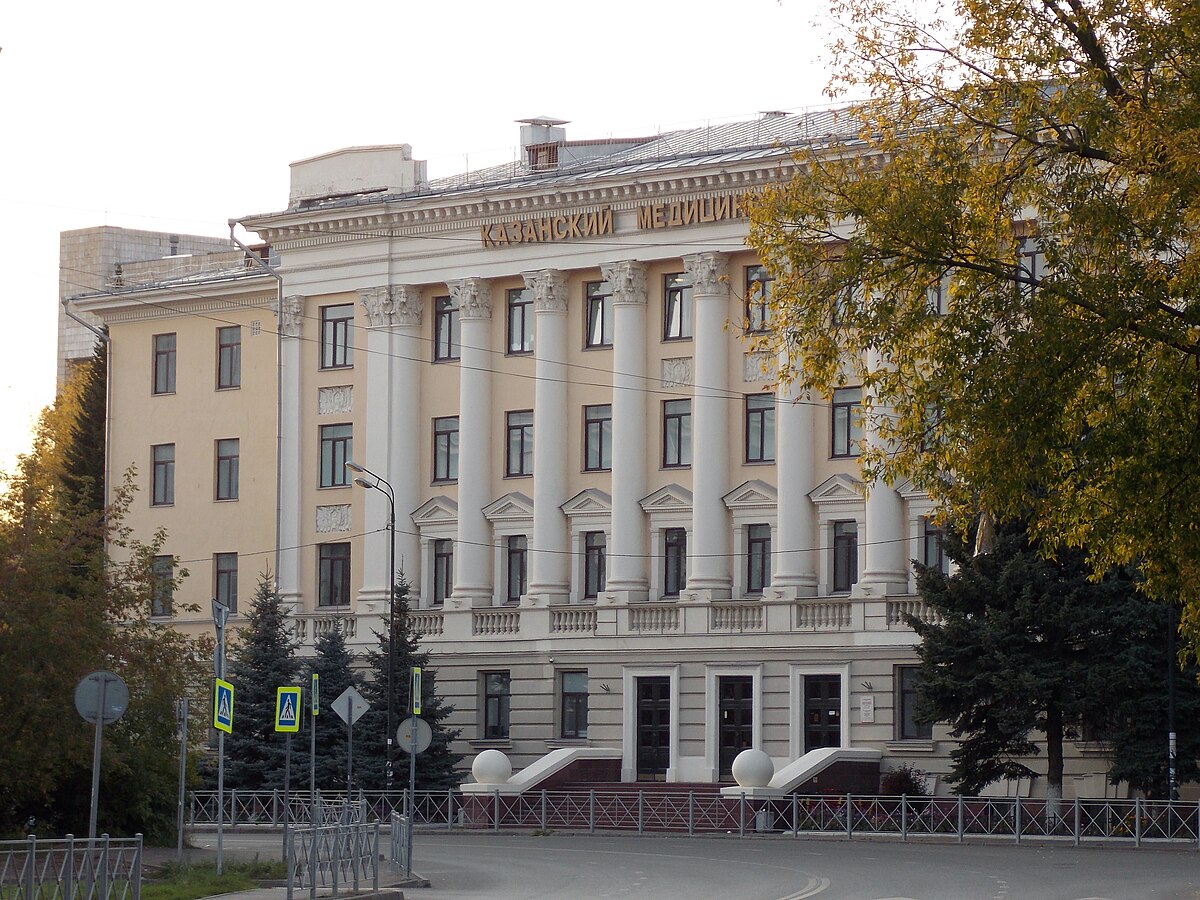
Russia has over 40 NMC-approved medical universities admitting Indian students every year. Many are affordable. Several are old. But Kazan State Medical University — KSMU — occupies a position that only two other institutions in the entire country can claim: it is the third oldest medical university in Russia, after only Moscow and Saint Petersburg, with institutional roots stretching back to 1814 — over 210 years of uninterrupted medical education heritage.
KSMU's story begins when Emperor Alexander I issued a royal decree in 1804 to establish a university in Kazan. In 1814, the Medical Faculty was inaugurated at Kazan Imperial University — making KSMU one of Russia's founding medical education institutions. Today KSMU has 9 faculties, 60 departments, 1,500+ staff, 6,000+ students, and 18+ affiliated teaching hospitals across Kazan.
For Indian students specifically, KSMU holds a position that no comparable institution in Russia can fully replicate. It has been offering English-medium MBBS to international students since 1996 — making it one of Russia's earliest and most experienced English-medium medical programmes, with over 30 years of continuous English-medium teaching. It has 800–1,000 Indian students currently enrolled — one of the largest Indian student communities at any Russian MBBS university. It has trained over 2,500 Indian doctors since the 1990s. And it operates on a self-cooking model that, combined with Kazan's well-established Indian grocery infrastructure, gives students full dietary autonomy in Russia's culturally vibrant 'Third Capital'.
KSMU at a Glance — Key Facts
| Factor | Details |
|---|---|
| University Full Name | Kazan State Medical University (KSMU) |
| Location | Kazan, Republic of Tatarstan, Russia — on the Volga and Kazanka rivers |
| Founded | 1814 — over 210 years; the third oldest medical university in Russia after Moscow and Saint Petersburg |
| Historical Roots | 1804: Emperor Alexander I decrees founding of Kazan University; 1814: Medical Faculty inaugurated; 1930: independent Kazan Medical Institute; 1994: university status |
| Unique Distinction | Third oldest medical university in all of Russia — only Moscow and Saint Petersburg surpass it in historical depth |
| Ranking | Ranked 3rd among Russian medical universities (ARES European Standard); top 5 for Indian students |
| English-Medium Since | 1996 — 30+ years; one of Russia's earliest English-medium MBBS programmes |
| Indian Doctors Trained | 2,500+ Indian doctors graduated since the 1990s |
| Degree Awarded | Doctor of General Medicine (equivalent to MBBS) |
| Course Duration | 6 years (pre-clinical + clinical + internship) |
| Medium of Instruction | English (core curriculum, since 1996) + Russian (clinical practice) |
| NMC Recognition | Yes — NMC, WHO, FAIMER, ECFMG & GMC (UK) recognised; WDOMS listed; FMGE / NExT eligible |
| Teaching Hospitals | 18+ affiliated hospitals across Kazan — one of Russia's largest regional clinical networks |
| Clinical Simulation | Centre for Practical Skills + 'Standardised Patient' department with trained patient actors |
| Faculty & Staff | 1,500+ staff; 9 faculties; 60 departments; members of prestigious national and international medical societies |
| Student Body | 6,000+ students; 2,000+ international from 50+ countries; 800–1,000 Indian students |
| Annual Tuition Fee | RUB 6,00,000 per year (fixed all 6 years — no annual escalation) |
| Hostel Fee | RUB 1,00,000 per year (all 6 years) — self-cooking kitchen facilities in hostel |
| Other Expenses | RUB 40,000 per year (Insurance + Visa Extension + Miscellaneous) |
| Total Per Year | RUB 7,40,000 per year (all 6 years) |
| Total 6-Year Cost | RUB 44,40,000 (approx. ₹54 Lakh at current rates) |
| Scholarships | Federal scholarship programme; 5% early-bird discount; merit-based awards |
| Academic Session | September (English-medium entry from 15th August) |
Over Two Centuries of Medical Excellence — The KSMU Story
The institutional history of Kazan State Medical University is one of the longest and most distinguished in all of Russian medicine. It begins not in the 20th century, not in the Soviet era, but in the age of the Russian Empire — when Emperor Alexander I issued a decree in 1804 to establish a university in Kazan. In 1814, the Faculty of Medicine was inaugurated at the Imperial Kazan University, holding its first council meeting on May 14th of that year. This date — May 14, 1814 — is considered the official founding date of what would become Kazan State Medical University.
The 19th century saw KSMU's predecessor institution develop into one of Russia's most distinguished centres of medical learning. In 1837, the Anatomical Theater was constructed — designed by M.P. Korinfsky with the participation of Nikolai Lobachevsky, the legendary mathematician who served as rector of Kazan Imperial University. By the late 19th century, Kazan's medical faculty had produced some of Russia's most significant physicians and scientists, with more than 30 academicians and corresponding members of the Russian Academy of Sciences and the Academy of Medical Sciences among its graduates.
In 1930, the Medical Faculty became the independent Kazan Medical Institute. Subsequent decades saw the addition of the Paediatric Faculty (1932), Dental Faculty (1956), Pharmaceutical Faculty (1975), and Postgraduate Education Faculty (1993). On April 29, 1994, the Kazan Medical Institute was upgraded to full university status as Kazan State Medical University. English-medium courses for international students were introduced in 1996 — making KSMU one of Russia's earliest pioneers of English-medium medical education, with over 2,500 Indian doctors trained in English medium since the 1990s.
The Kazan Advantage — Russia's Third Capital and the Republic of Tatarstan
Kazan is not simply another Russian regional city. It is the capital of the Republic of Tatarstan — one of Russia's most culturally distinct and economically dynamic federal subjects — and is widely referred to as Russia's 'Third Capital' after Moscow and Saint Petersburg. With a population of approximately 1.3 million people, Kazan is Russia's sixth most populous city, the largest city on the Volga River, and one of the country's most internationally recognised destinations. It hosted the 2013 Summer Universiade, the 2015 World Aquatics Championships, and was one of the host cities of the 2018 FIFA World Cup.
Kazan's distinctiveness lies in its dual cultural identity. The city is the historic capital of the Kazan Khanate and has been a centre of Tatar culture, language, and Islamic tradition for centuries — coexisting with Russian Orthodox culture in a remarkable example of multicultural civic life. The result is a city unlike any other in Russia: where Orthodox churches and mosques stand side by side, where Russian and Tatar languages are both official, and where the Kazan Kremlin — a UNESCO World Heritage Site — contains both an Orthodox cathedral and a mosque within the same fortress complex.
- Russia's 'Third Capital' — Kazan is Russia's sixth most populous city, host of FIFA World Cup 2018 and Summer Universiade 2013; world-class infrastructure and international orientation
- Unique dual cultural identity — Tatar and Russian cultures coexist; mosques and Orthodox churches stand side by side; a genuinely multicultural city unlike any other in Russia
- Kazan Kremlin — UNESCO World Heritage Site — one of Russia's most impressive architectural complexes; contains both Orthodox cathedral and mosque within one fortress
- Kazan International Airport — direct and connecting flights to Moscow and major cities; no domestic transfer required for many routes
- 820 km from Moscow — domestic flight under 2 hours; express train ~11 hours; Indian Embassy and major supplies accessible
- 800–1,000 Indian students at KSMU — established Indian grocery networks and cooking communities throughout the city; best-mapped Indian food supply of any regional Russian MBBS university
- Self-cooking hostel model — Indian spices, pulses, rice, and staples available in Kazan's markets and specialist stores
- Vibrant student city — Volga and Kazanka riverfront; multiple universities; cultural events; sports facilities of FIFA World Cup standard
Clinical Training at KSMU — 18+ Hospitals, Simulation Centre & Standardised Patients
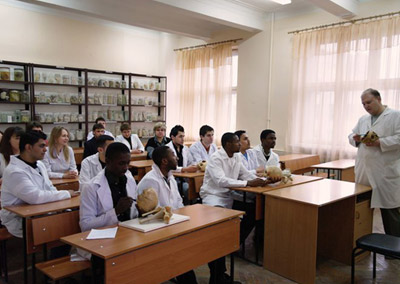
KSMU's clinical training is conducted across 18+ affiliated hospitals and medical facilities throughout Kazan — a city of 1.3 million that provides one of the strongest patient flows of any Russian university city outside Moscow and Saint Petersburg. From Year 4 onwards, students rotate through KSMU's clinical departments gaining structured exposure across the full spectrum of medical specialties: Internal Medicine, Surgery, Obstetrics and Gynaecology, Paediatrics, Neurology, Psychiatry, ENT, Ophthalmology, Oncology, Dermatology, Infectious Diseases, and more.
KSMU's clinical infrastructure includes significant investment in modern simulation training. The university's Centre for Practical Skills and the 'Standardised Patient' department — where clinical scenarios are simulated with trained actors playing patients — provide pre-clinical and clinical students with structured, realistic patient interaction training that directly builds the practical competencies tested by FMGE / NExT. This simulation-based approach, combined with 18+ hospital affiliates in a major city, gives KSMU students among the most comprehensive clinical preparation available at any NMC-approved Russian medical university.
- 18+ affiliated hospitals across Kazan — one of Russia's largest clinical training networks outside Moscow and Saint Petersburg
- City of 1.3 million — strong patient flow providing high volume and diversity of clinical cases
- Centre for Practical Skills — advanced simulation centre for structured pre-clinical and clinical skills training
- 'Standardised Patient' department — clinical scenarios with trained patient actors; direct preparation for FMGE / NExT practical assessments
- 9 faculties and 60 departments — General Medicine, Paediatrics, Dentistry, Pharmacy, Preventive Medicine and more
- OSCE-style practical examinations in Year 6 — directly aligned with FMGE / NExT clinical competency requirements
- Year 6 internship rotations across all major specialties in a structured, fully supervised programme
Course Structure & Curriculum at KSMU — Year by Year
KSMU's General Medicine programme follows the 6-year structured curriculum standard to Russian-model medical universities, fully aligned with NMC requirements for international recognition. The English-medium programme — in continuous operation since 1996, making it one of Russia's most experienced — delivers the same academic content at the same standard as the Russian-medium programme. KSMU's curriculum is built on the academic tradition of a 210-year institution whose faculty includes members of prestigious national and international medical societies.
| Year | Phase | Subjects / Focus Areas |
|---|---|---|
| Year 1 | Pre-Clinical | Anatomy, Histology, Biochemistry, Biophysics, Latin, Russian Language (Beginner) |
| Year 2 | Pre-Clinical | Physiology, Microbiology, Pathological Anatomy, Russian Language (Intermediate) |
| Year 3 | Para-Clinical | Pathophysiology, Pharmacology, Propedeutics of Internal Medicine, Russian Language (Clinical) |
| Year 4 | Clinical | Internal Medicine, Surgery, Paediatrics, Neurology, Psychiatry — Hospital rotations across KSMU's 18+ affiliated hospitals in Kazan |
| Year 5 | Clinical | Obstetrics & Gynaecology, ENT, Ophthalmology, Infectious Diseases, Oncology, Dermatology |
| Year 6 | Internship | All-department rotations, OSCE Exams, Standardised Patient assessments, Final State Examinations, Clinical Internship |
Pre-Clinical Years (1–2) — Foundation Building at Russia's Third Oldest Medical Institution
The first two years at KSMU establish the foundational sciences — Anatomy, Physiology, Biochemistry, Histology, and Microbiology — within an institution whose medical faculty has been teaching these subjects since 1814. The depth and continuity of academic tradition in KSMU's pre-clinical departments is not replicated at younger institutions. The university's 1,500+ staff across 60 departments bring a breadth of specialist expertise to pre-clinical teaching that reflects over two centuries of accumulated medical education experience. Russian language training begins from Day 1.
Para-Clinical Year (3) — The FMGE-Critical Year
Year 3 is strategically the most important year for FMGE / NExT preparation. Pathology, Pharmacology, and Propedeutics of Internal Medicine carry the heaviest examination weightage. At KSMU, these subjects are taught within an institution whose depth of faculty expertise reflects 210 years of medical teaching tradition. The Propedeutics course formally bridges foundational science and hospital-based clinical medicine, beginning the preparation for full ward rotations in Year 4.
Clinical Years (4–6) — Kazan's 18+ Hospital Network and Simulation Training
From Year 4, students enter KSMU's network of 18+ affiliated hospitals across Kazan for structured clinical rotations. Year 5 covers the remaining clinical disciplines. Year 6 is the comprehensive internship year — all-department rotations, OSCE examinations, Standardised Patient assessments, and the final state examination. The combination of 18+ hospital sites in a city of 1.3 million and KSMU's advanced simulation infrastructure gives students clinical preparation that is among the most comprehensive available in Russia. Students who invested in Russian from Years 1–3 communicate directly with patients, engage fully in ward rounds, and get the maximum possible benefit from Kazan's rich clinical environment.
Complete Fee Structure — Year by Year (in Russian Rubles)
KSMU's fee structure is transparent and fully defined. Three components — tuition, hostel, and other expenses — are consistent across all 6 years. Total: RUB 7,40,000 per year, identical for every year, with no annual escalation. Fees are fixed for all 6 years.
| Year | Tuition (RUB) | Hostel (RUB) | Other Exp. (RUB) | Total/Year (RUB) |
|---|---|---|---|---|
| Year 1 | 6,00,000 | 1,00,000 | 40,000 | 7,40,000 |
| Year 2 | 6,00,000 | 1,00,000 | 40,000 | 7,40,000 |
| Year 3 | 6,00,000 | 1,00,000 | 40,000 | 7,40,000 |
| Year 4 | 6,00,000 | 1,00,000 | 40,000 | 7,40,000 |
| Year 5 | 6,00,000 | 1,00,000 | 40,000 | 7,40,000 |
| Year 6 | 6,00,000 | 1,00,000 | 40,000 | 7,40,000 |
| TOTAL | 36,00,000 | 6,00,000 | 2,40,000 | 44,40,000 RUB |
What the Fee Includes
- Tuition fees — RUB 6,00,000 per year, fixed and consistent across all 6 years with no annual escalation
- On-campus hostel accommodation — RUB 1,00,000 per year, consistent across all 6 years
- Self-cooking kitchen facilities in the hostel — students prepare their own meals with full dietary control
- Medical and health insurance — mandatory for all international students (included in other expenses)
- Visa renewal / extension charges — required annually to maintain legal student status in Russia (included in other expenses)
- Miscellaneous administrative and student services charges — included in the RUB 40,000 other expenses figure
Self-Cooking Model — Food Arrangement at KSMU
KSMU operates on a self-cooking model — there is no university mess. Students cook their own meals in hostel kitchen facilities. With 800–1,000 Indian students at KSMU, the knowledge of where to source Indian ingredients in Kazan is comprehensively mapped and freely shared within the Indian student community. Indian spices, lentils, pulses, rice, and cooking staples are available from specific markets, stores, and suppliers that the Indian student community has identified and used for decades. Monthly food costs for self-cooking students are typically RUB 10,000–15,000 (approximately ₹8,500–13,000). Students who prefer not to cook every day also have access to university cafeterias and local restaurants.
KSMU vs Other NMC-Approved Russian Universities — Honest Comparison
| Factor | Kazan State Medical University | Typical NMC-Approved Russian University |
|---|---|---|
| Founded | 1814 — 210+ years; third oldest medical university in Russia after Moscow and Saint Petersburg | Varies; many post-1990 institutions |
| Institutional Age Rank | 3rd oldest medical university in all of Russia — no NMC-approved regional Russian university has older roots | Cannot claim comparable historical rank |
| English-Medium History | English-medium MBBS since 1996 — 30+ years of experience; 2,500+ Indian doctors trained | Many started English programmes post-2000 |
| NMC Recognition | NMC, WHO, FAIMER, ECFMG & GMC (UK) — well-established and continuous | Varies; verify each individually |
| Teaching Hospitals | 18+ affiliated hospitals; Centre for Practical Skills; Standardised Patient department | Varies in breadth; simulation infrastructure uncommon |
| Indian Students | 800–1,000 Indian students — one of the largest Indian communities at any regional Russian MBBS university | Varies widely |
| Annual Tuition | RUB 6,00,000/year — fixed all 6 years; no escalation | RUB 2,50,000–7,00,000 (wide range) |
| Food Arrangement | Self-cooking hostel kitchens; Indian ingredients comprehensively available; large Indian community for guidance | Varies by university |
| Total 6-Year Cost | RUB 44,40,000 — fully transparent; no annual increases | RUB 18,00,000–50,00,000 (varies) |
| City Profile | Kazan — Russia's Third Capital; FIFA World Cup 2018 host; UNESCO Kremlin; 1.3 million people | Varies — regional cities, smaller towns |
Eligibility & Admission Process for KSMU
Eligibility Criteria
- Cleared NEET (mandatory under NMC rules — no exceptions for any foreign medical university)
- Class 12 with Physics, Chemistry, and Biology — minimum 50% aggregate in PCB (40% for SC/ST/OBC)
- Minimum age 17 years on or before 31st December of the year of admission
- Valid Indian passport
Step-by-Step Admission Process
- NEET Qualification: Confirm your NEET scorecard. No application to any foreign medical university can proceed without a valid NEET qualification.
- Application Submission: Submit Class 10 and 12 marksheets, NEET scorecard, and passport copy to KSMU's admissions office via MBBSDirect.com.
- University Review & Invitation Letter: KSMU reviews the application and issues an official invitation letter on university letterhead — required to apply for a Russian student visa.
- First-Year Fee Payment: Pay Year 1 fees (RUB 7,40,000 total) to KSMU's official bank account and retain all payment receipts.
- Student Visa Application: Apply at the Russian Embassy or through VFS in India with the invitation letter, academic documents, medical certificate, and passport. Processing typically takes 3–6 weeks.
- Travel & Arrival: KSMU assists with coordination on arrival. Kazan has its own international airport — students fly directly to Kazan without a domestic connection. English-medium entry from 15th August. Classes begin in September.
Documents Required
- Class 10 Marksheet & Certificate (attested / apostilled)
- Class 12 Marksheet & Certificate (attested / apostilled)
- NEET Score Card (original + copies)
- Valid Indian Passport (minimum 1.5 years validity from travel date)
- 10 Passport-size photographs
- Birth Certificate (attested)
- Medical Fitness Certificate (from a registered doctor)
- Police Clearance Certificate
- Migration Certificate (from Class 12 board)
Life at KSMU — Kazan, Hostel, Food & Student Community
Location — Kazan, Republic of Tatarstan
Kazan is one of Russia's most extraordinary cities — a metropolis of 1.3 million at the confluence of the Volga and Kazanka rivers, capital of the Republic of Tatarstan, and the city that Russians themselves call the 'Third Capital.' Founded over 1,000 years ago, Kazan has been a major centre of Tatar, Islamic, and Russian culture for centuries. The Kazan Kremlin — a UNESCO World Heritage Site at the city's heart — stands as a symbol of this dual heritage, its towers and minarets and Orthodox churches all within one fortress complex. The city hosted the 2013 Summer Universiade and 2018 FIFA World Cup, which left it with world-class sports facilities, urban infrastructure, and an international orientation that few Russian cities outside Moscow and Saint Petersburg can match.
Hostel — On-Campus Accommodation with Self-Cooking
KSMU provides on-campus and near-campus hostel accommodation for international students at RUB 1,00,000 per year — consistent across all 6 years. Hostel rooms are available in double-sharing (most common) and triple-sharing configurations. KSMU's hostels include kitchen facilities where students cook their own meals, providing complete dietary autonomy. The hostels have 24-hour security, Wi-Fi, hot water, and central heating. On-campus accommodation places students within the university community immediately, and the large Indian student cohort at KSMU means new arrivals are never without senior guidance from Day 1.
Food — Self-Cooking with Kazan's Established Indian Supply Network
KSMU operates on a self-cooking model — there is no university mess. Students cook their own meals in hostel kitchen facilities. With 800–1,000 Indian students at KSMU, the knowledge of where to source Indian ingredients in Kazan is the most comprehensively mapped and shared of any Russian MBBS university outside Moscow and Saint Petersburg. Indian spices, lentils, pulses, rice varieties, and cooking essentials are available from specific markets, stores, and suppliers that the Indian student community has identified and used for decades. Kazan's multicultural Tatar bazaars and diverse food markets also provide a wide range of ingredients compatible with Indian cooking. Monthly food costs for self-cooking students are typically RUB 10,000–15,000 (approximately ₹8,500–13,000).
Student Life — Russia's Most Culturally Vibrant University City
Student life at KSMU in Kazan is shaped by the extraordinary character of the city itself — a multicultural, historically layered, internationally experienced metropolis. KSMU's cultural programme celebrates the diversity of its international student body — with events showcasing national music, dance, and traditions from the 50+ countries represented. Indian students at KSMU are among the most active participants in campus cultural life, organising Diwali celebrations, festivals, and cultural evenings that have become fixtures of the KSMU calendar.
Russian Language — Your Most Important Investment
KSMU provides structured Russian language training from Year 1 as part of the formal curriculum. Russian language is essential for clinical years — hospital environments across Kazan's 18+ affiliated hospitals operate in Russian, and patients and staff communicate in Russian. Students who invest seriously in Russian from Year 1 have dramatically better clinical year experiences. The immersive multilingual environment of Kazan — where Russian, Tatar, and multiple international languages intersect in daily city life — provides natural language acquisition opportunities that accelerate practical Russian.
Climate — Kazan Seasons
- Winter (November–March): −10°C to −20°C — cold continental winters with significant snowfall; proper warm clothing is essential
- Spring (April–May): 5°C to 15°C — Kazan warms quickly; the Volga and Kazanka rivers are stunning as ice breaks
- Summer (June–August): 18°C to 28°C — warm, beautiful Kazan summers; the Volga waterfront and the city's parks are magnificent
- Autumn (September–October): 5°C to 15°C — mild and colourful; the academic year begins in very pleasant conditions
- KSMU hostels and all university buildings are centrally heated — indoor comfort is maintained throughout winter
- Kazan winters are cold but characteristic of central Russia; Indian students adapt well within the first season with appropriate clothing
Who Should Choose KSMU?
✓ KSMU is the right choice if:
- You want to study at the third oldest medical university in Russia — an institution with 210+ years of heritage that only Moscow and Saint Petersburg universities can surpass in historical depth
- You value 30+ years of English-medium MBBS experience — KSMU introduced English-medium courses in 1996 and has refined its English programme for three decades; 2,500+ Indian doctors trained
- You want the largest established Indian student community of any regional Russian MBBS university — 800–1,000 Indian students currently enrolled
- You are comfortable with the self-cooking model — and appreciate the dietary freedom and cost management it provides, supported by Kazan's well-mapped Indian food supply network
- You want 18+ affiliated hospitals in a city of 1.3 million, combined with a Centre for Practical Skills and Standardised Patient department — among the richest clinical preparation in Russia
- You want to study in Russia's 'Third Capital' — Kazan's cultural richness, FIFA World Cup infrastructure, UNESCO Kremlin, and Tatar-Russian dual identity make it one of Russia's most extraordinary cities
- Your budget supports RUB 7,40,000 per year for all 6 years — total RUB 44,40,000 over 6 years, approx. ₹38–44 Lakh at current rates
- You are willing to invest seriously in Russian language learning — understanding that Kazan's multilingual environment supports this investment naturally
✗ Consider alternatives if:
- Your budget requires the lowest-cost Russian university options — KSMU's fee reflects its third-oldest ranking and institutional depth; there are universities with lower total fees
- You require a university mess / catering service — KSMU operates a self-cooking model; students cook their own meals in hostel kitchens
- You specifically require a university in Moscow or Saint Petersburg — Kazan is 820 km from Moscow
- You are not willing to invest in Russian language learning — clinical years at any Russian university require it
- Seats are already full for the upcoming intake — in which case MBBSDirect.com can advise on alternatives or next-year planning
Pre-Departure Checklist — Before You Fly to KSMU, Kazan
Document / Administrative
- NEET scorecard (original + 3 copies)
- Official KSMU offer / invitation letter (original)
- Student visa stamped in passport
- Year 1 fee payment receipt (RUB 7,40,000)
- Class 10 & 12 certificates (attested/apostilled originals)
- Passport validity: minimum 1.5 years from travel date
- Medical fitness certificate (from registered doctor)
- Police clearance certificate
- Medical insurance confirmation document
Practical / Personal
- Warm winter clothing (jacket, thermals, boots, gloves)
- Indian medicines and personal health supplies (3–6 months)
- Debit card with international ATM access + some USD/EUR for arrival
- Indian grocery staples, spices, and cooking essentials for first few weeks
- KSMU Indian student WhatsApp group joined (via MBBSDirect.com)
- Russian language basics app downloaded and practised
- Flight booked to Kazan International Airport (direct or via Moscow)
- Emergency contact list (family + KSMU + Indian Embassy Moscow)
- University registration documents printed and organised
The Bottom Line — Is KSMU Right for You?
Kazan State Medical University is not simply a regional Russian medical university. It is the third oldest medical university in all of Russia — surpassed in age only by Moscow and Saint Petersburg — with over 210 years of continuous medical education heritage, more than 30 academicians among its graduate alumni, and a ranking of third among Russian medical universities. It has been teaching medicine in English since 1996. It has trained over 2,500 Indian doctors. It has 800–1,000 Indian students currently in residence. It has 18+ affiliated hospitals in a city of 1.3 million, a Centre for Practical Skills, and a Standardised Patient department. And it is located in Kazan — Russia's 'Third Capital,' host of the FIFA World Cup 2018, home of the UNESCO-listed Kazan Kremlin, and one of Russia's most culturally extraordinary cities.
The 210-year heritage matters — KSMU's academic culture, faculty depth, and institutional character were shaped not over decades but over centuries. The English-medium experience matters — 30 years of English-medium teaching means KSMU's faculty knows how to teach Indian students effectively in ways that newer programmes are still learning. The Indian community matters — 800–1,000 students means KSMU's self-cooking model is supported by one of the best-developed Indian food knowledge networks in Russia. The clinical depth matters — 18+ hospitals, simulation infrastructure, and Standardised Patient training represent clinical preparation at a level outside Moscow and Saint Petersburg that few other Russian MBBS universities can match.
If you would like to apply to KSMU or want to discuss whether it is the right fit for your specific situation, the team at MBBSDirect.com is here for an honest conversation. We will tell you if KSMU is right for you — and if it is not, we will tell you that too.
www.mbbsdirect.com — Your trusted guide to MBBS abroad — honest advice, direct admissions, no hidden charges.